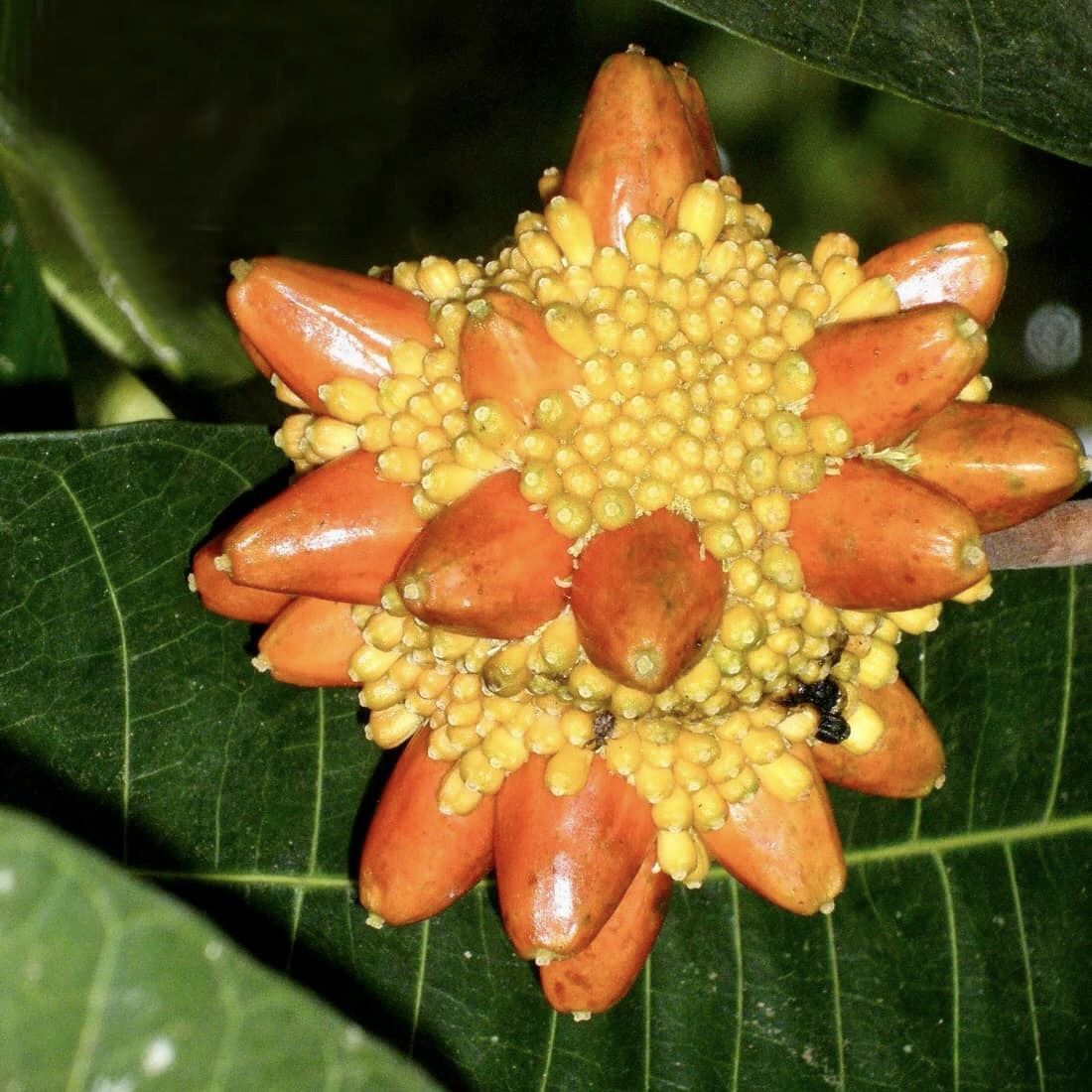
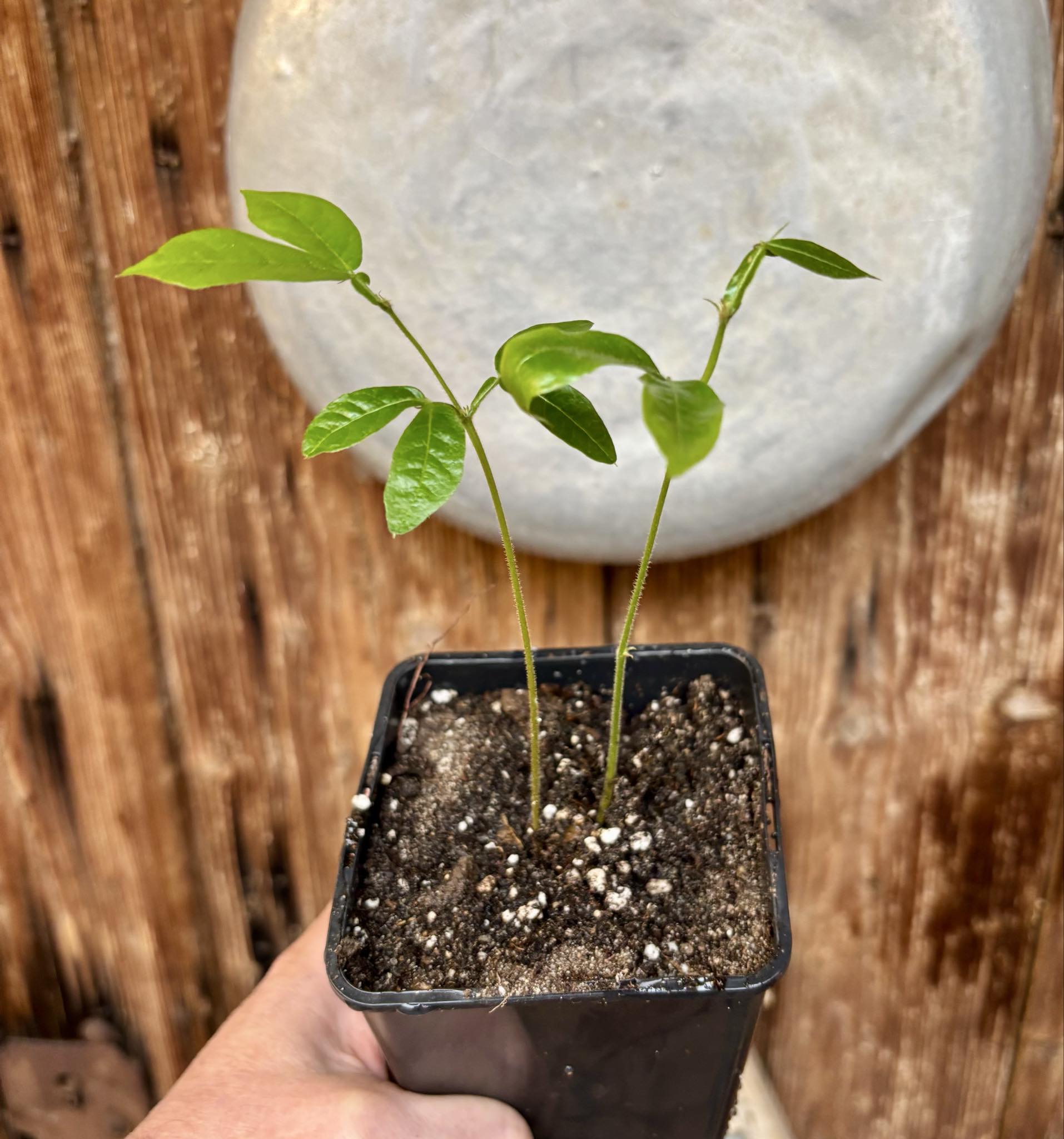
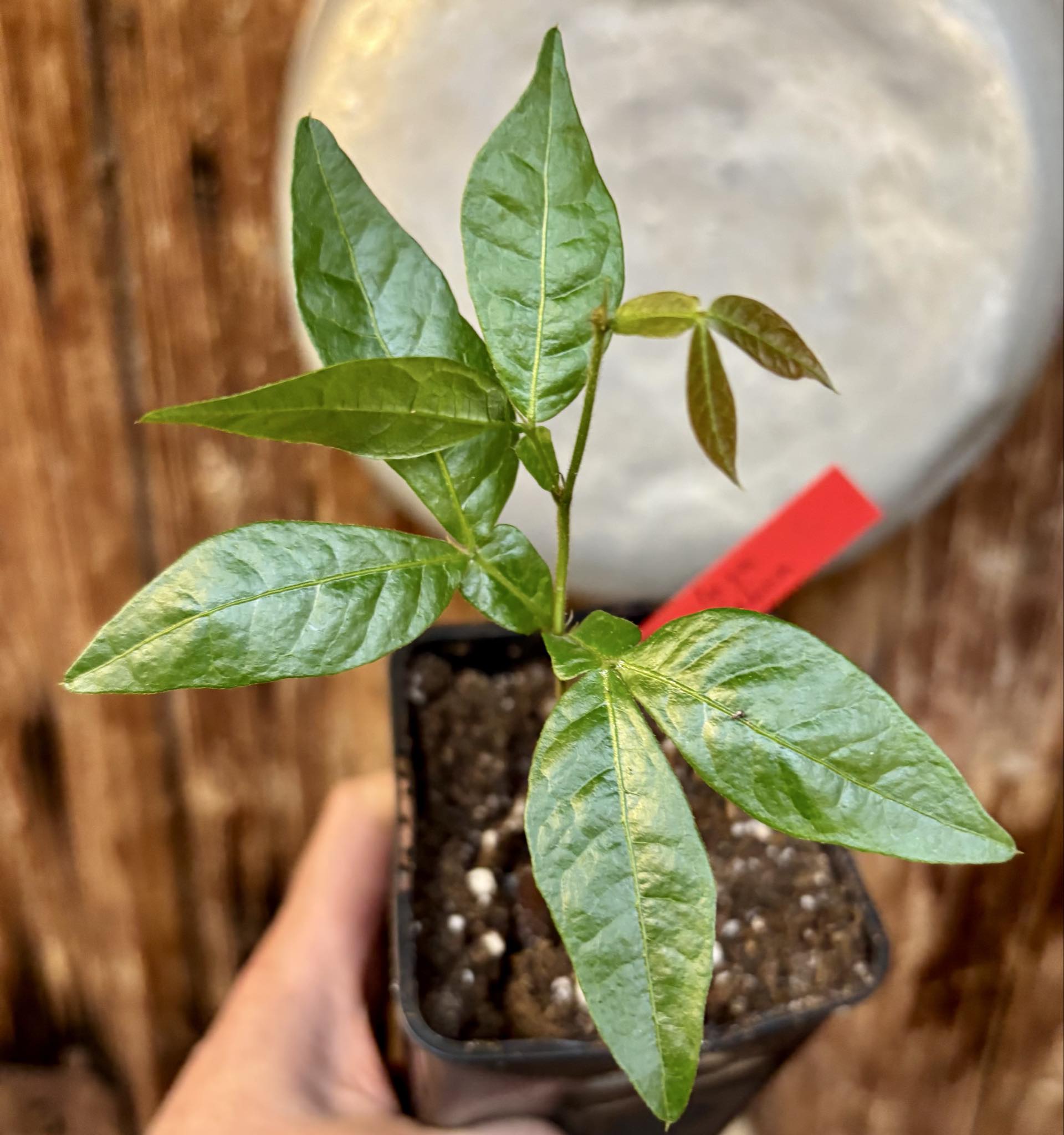
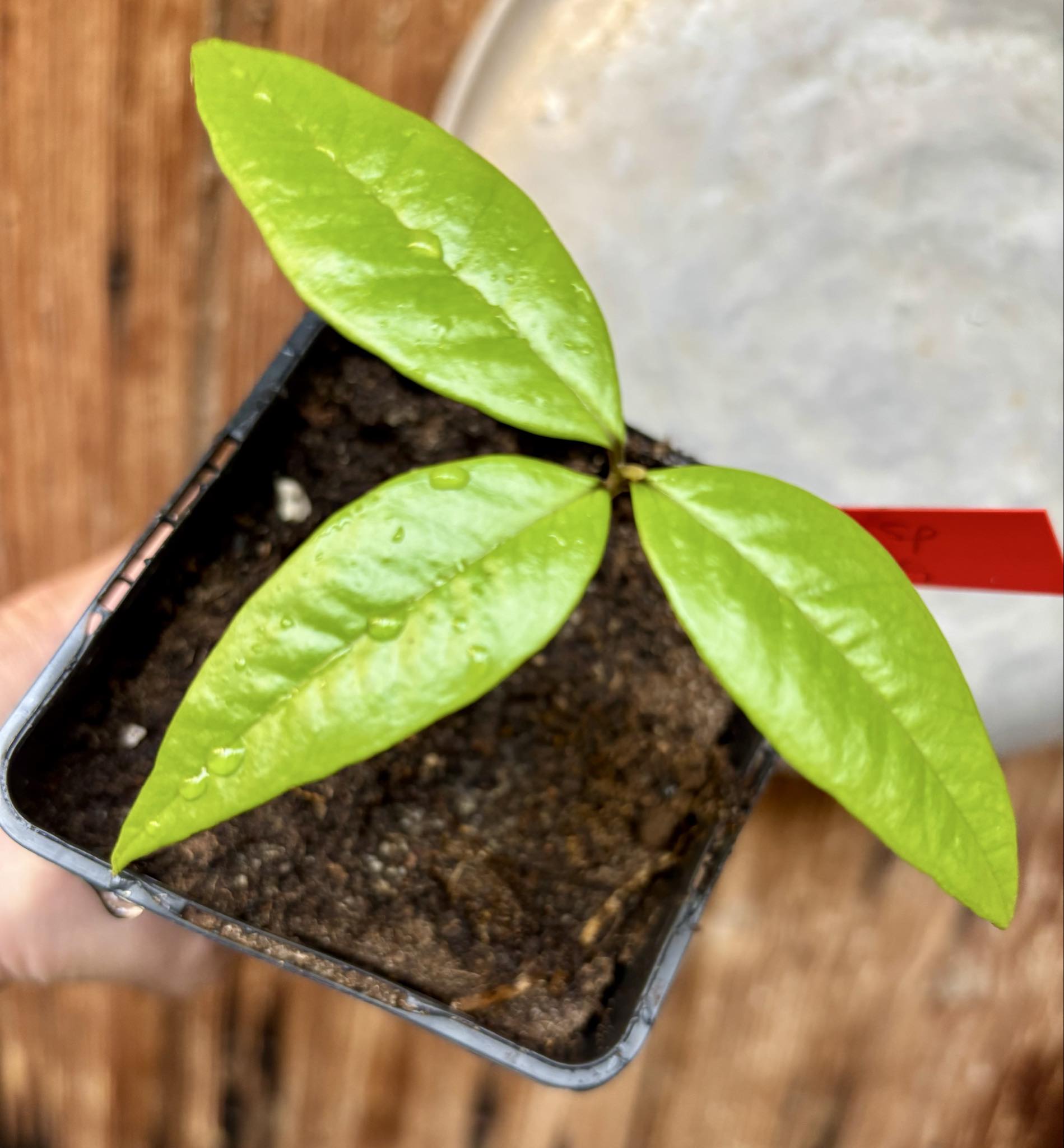
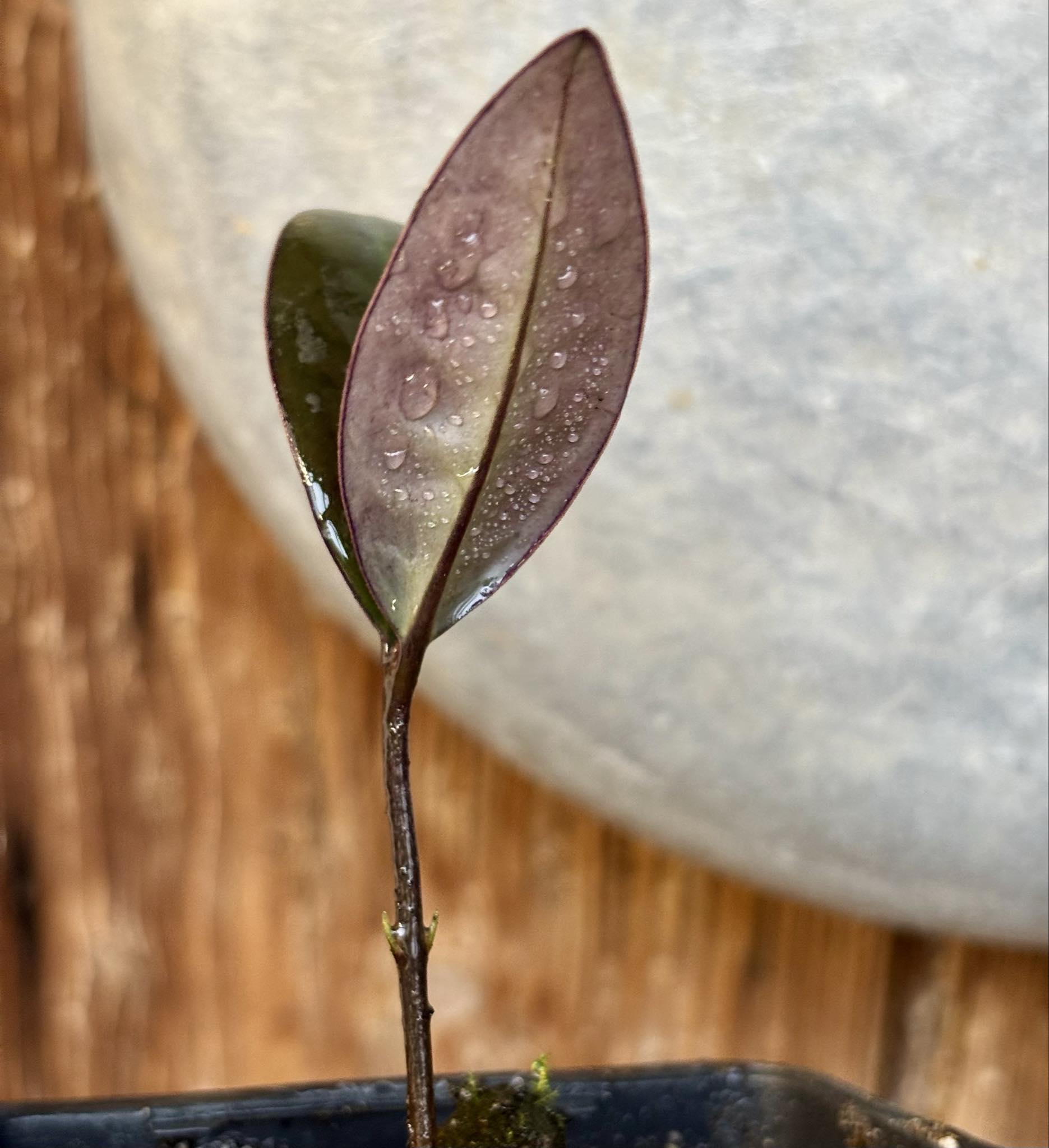
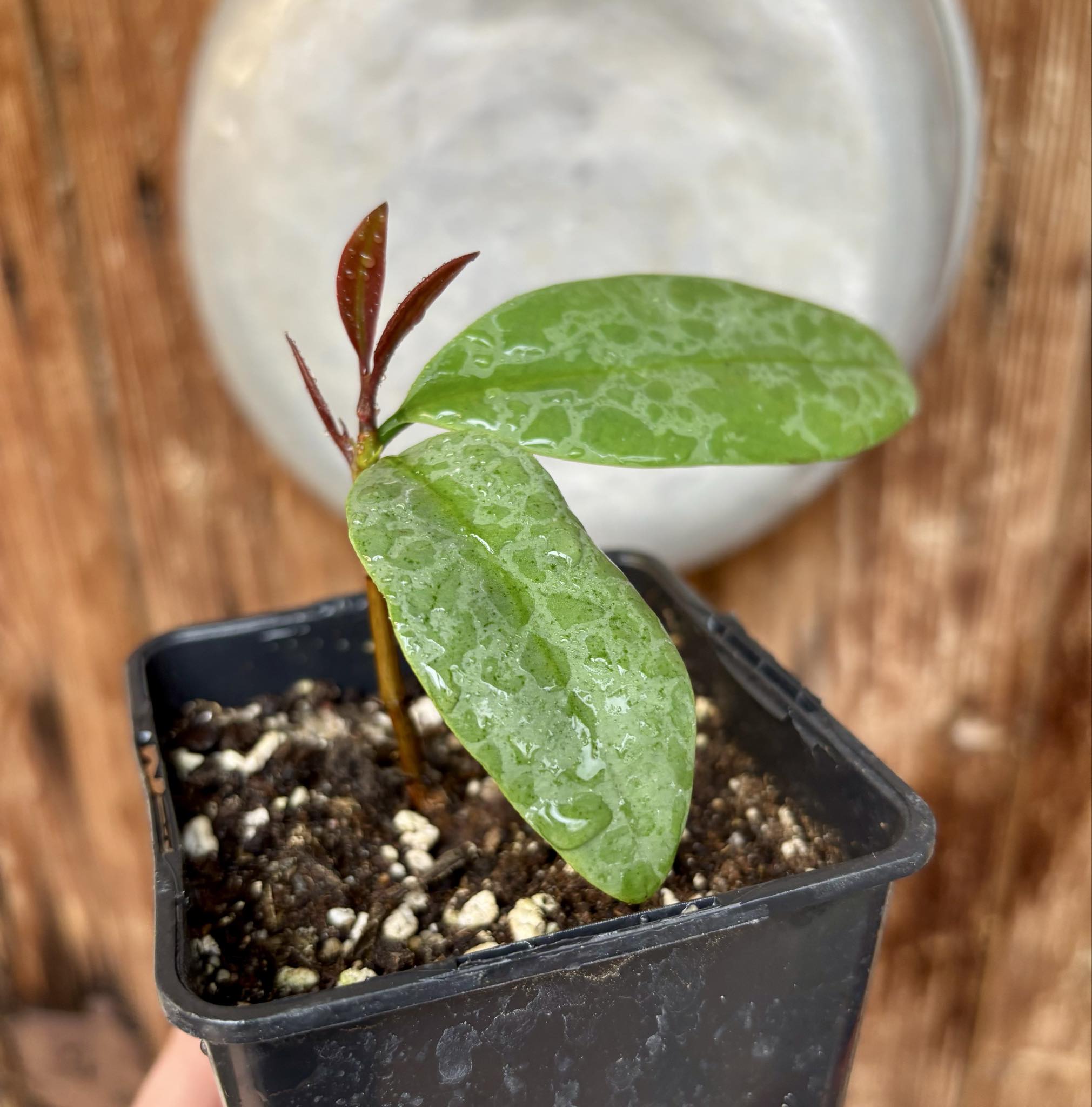
Kesusu (Prainea limpato)
Family / Familie: Moraceaeorigin from / Herkunft: BorneoClimate / Klima: warm (15-30C / 60-84F) / warm (15-30C / 60-84F) Use / Verwendung: edible fruits, juice, jam, ice cream, etc. / essbare Früchte, Säfte, Marmelade, Eis usw.you buy / sie kaufen: 1 potted seedling / 1 getopfter Sämling
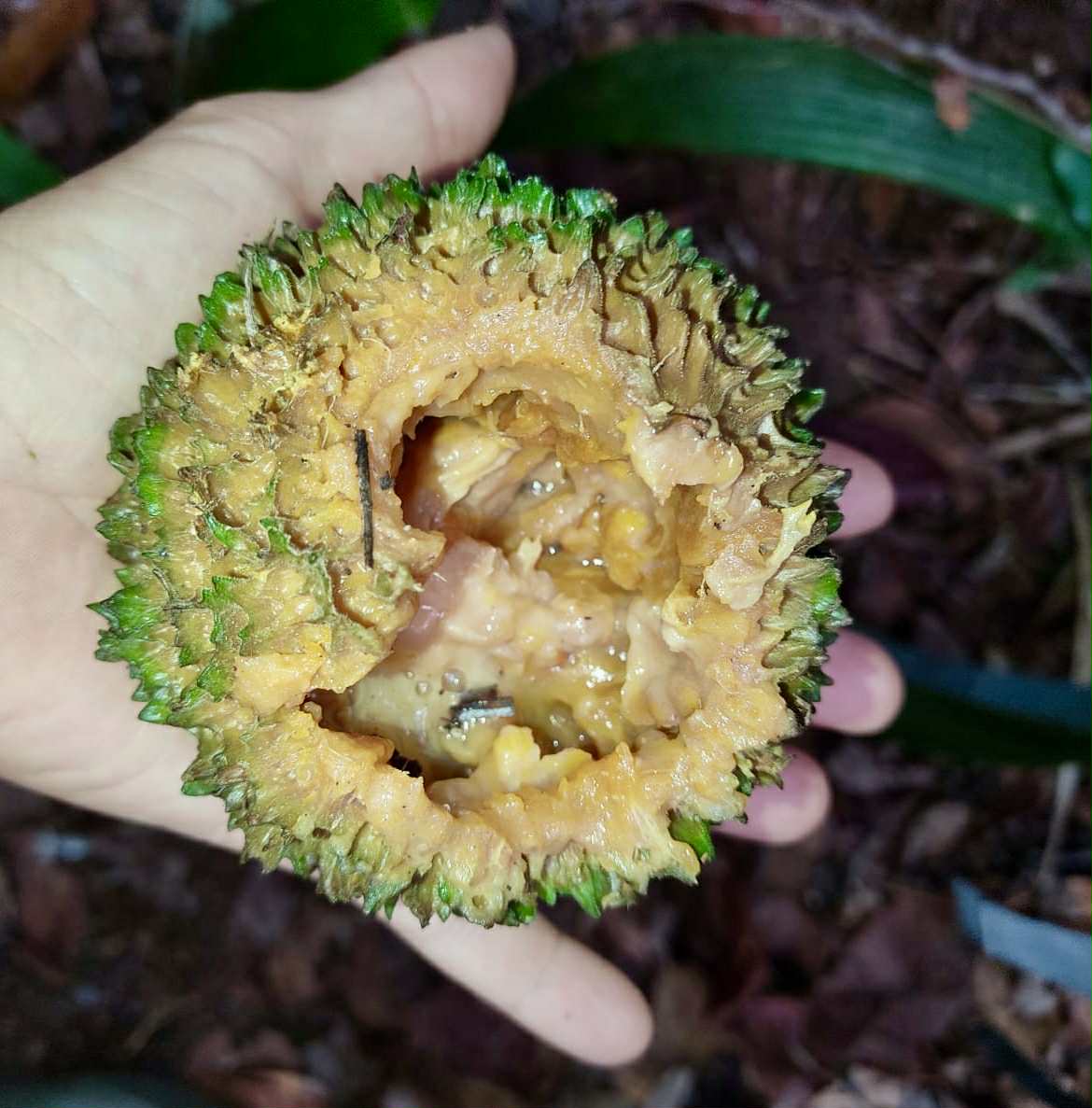
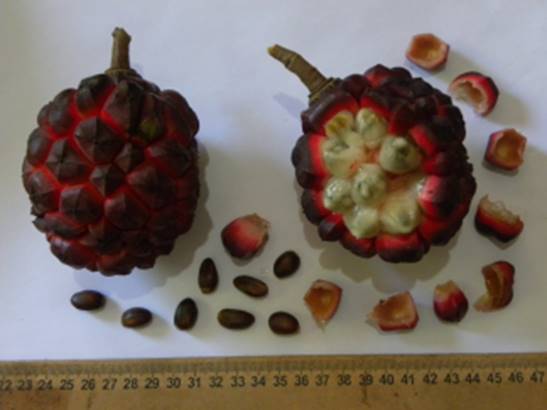
Delivery EU only“Kesusu” - the legendary Borneo fruit.For a long time, this fruit was considered unattainable for collectors.The first fruits have now been harvested in Hawaii and the myth that it is “one of the best fruits in the world” has been confirmed.Like the fig or jackfruit, the Kesusu belongs to the Moraceae family and is endemic to Borneo.The fruits have several segments that can be eaten.The flesh is very sweet and tastes like caramelized sugar with butterscotch.The plant needs the same conditions as cocoa. Warm, moist and part shade in the first year.Please overwinter at a temperature of at least 15 degrees.„Kesusu“ - die legendäre Borneo Frucht.Lange Zeit galt diese Frucht als unerreichbar für Sammler.Mittlerweile konnten erste Früchte in Hawaii geerntet werden und der Mythos „eine der besten Früchte der Welt“ zu sein, hat sich bestätigt.Die Kesusu gehört wie die Feige oder die Jackfrucht zur Familie der Moraceae und ist endemisch in Borneo.Die Früchte haben mehrere Segmente, die man essen kann.Das Fruchtfleisch ist sehr süß und schmeckt nach karamellisierten Zucker mit Butterscotch. Die Pflanze benötigt die gleichen Bedingungen wie Kakao. Warm, feucht und Halbschatten im ersten Jahr.Bitte bei mindestens 15 Grad überwintern.
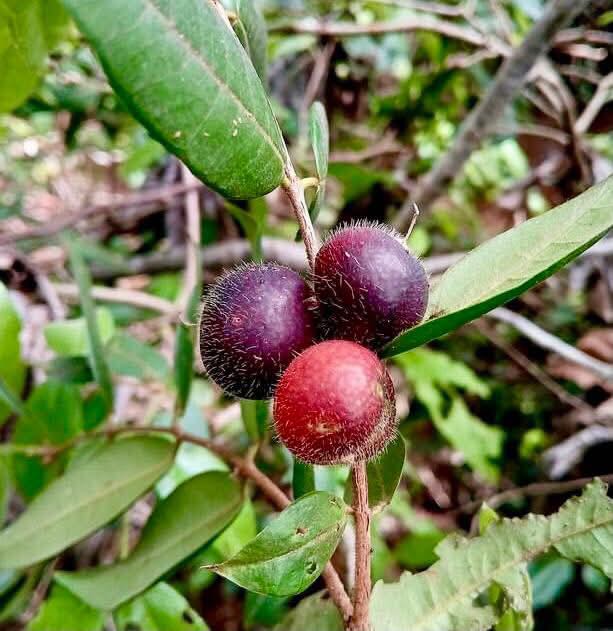
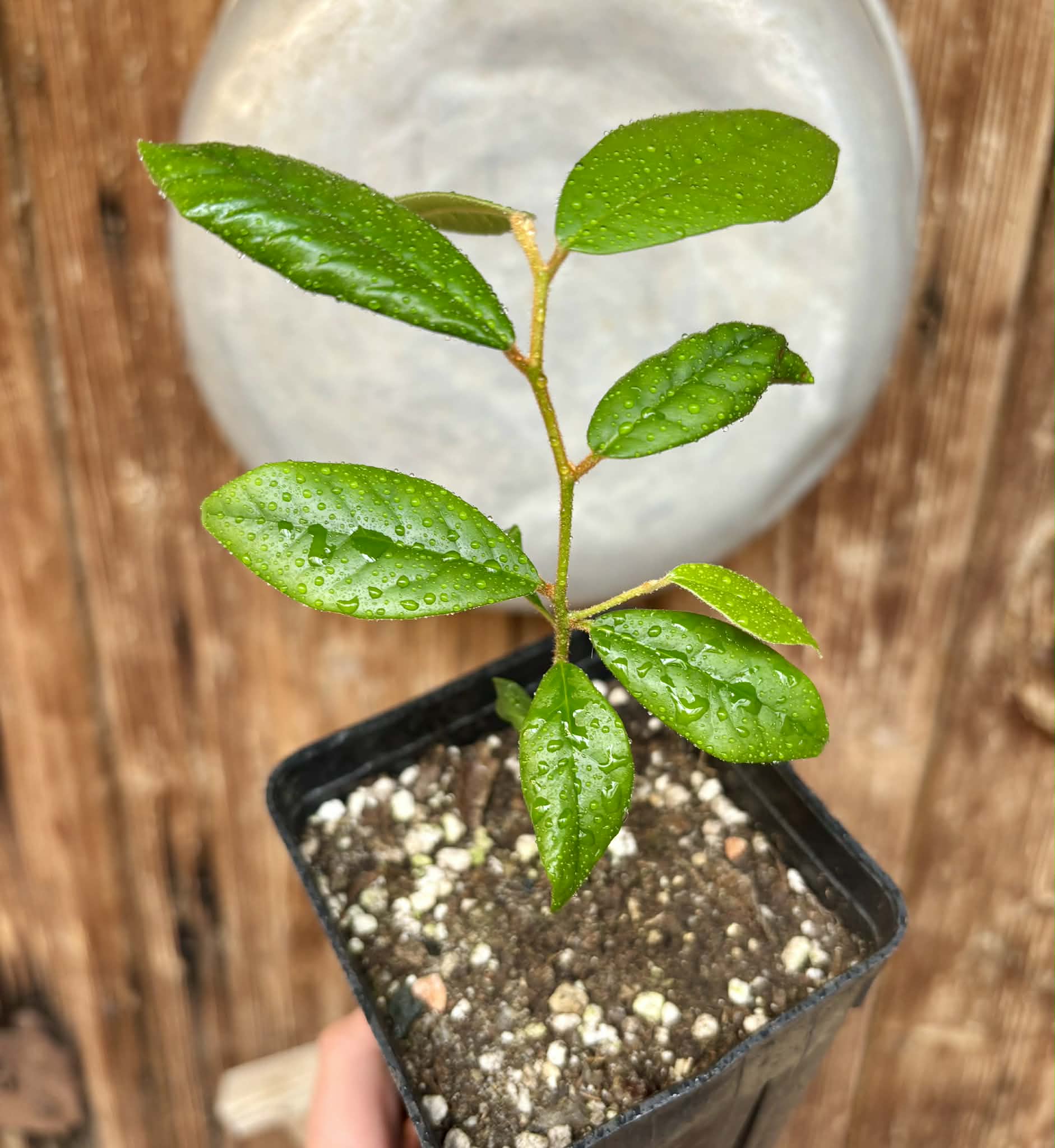
Myrciaria sp Cabeludinha preta (Blue Glomerata)
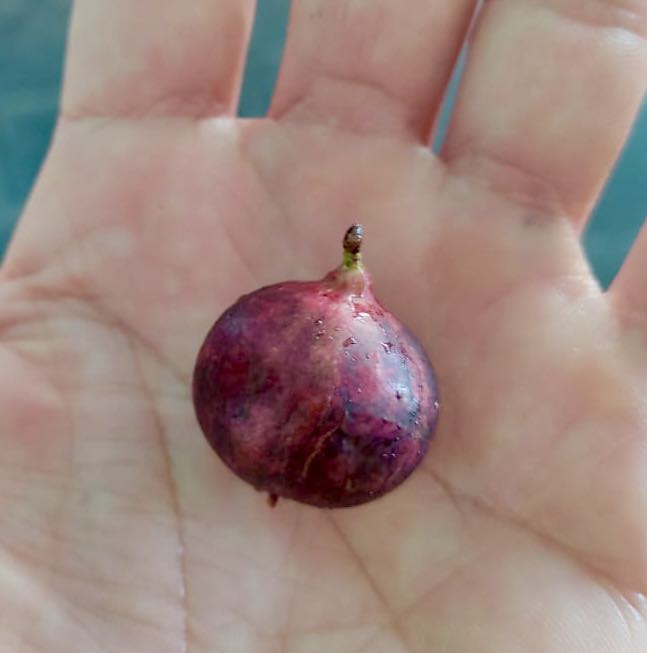
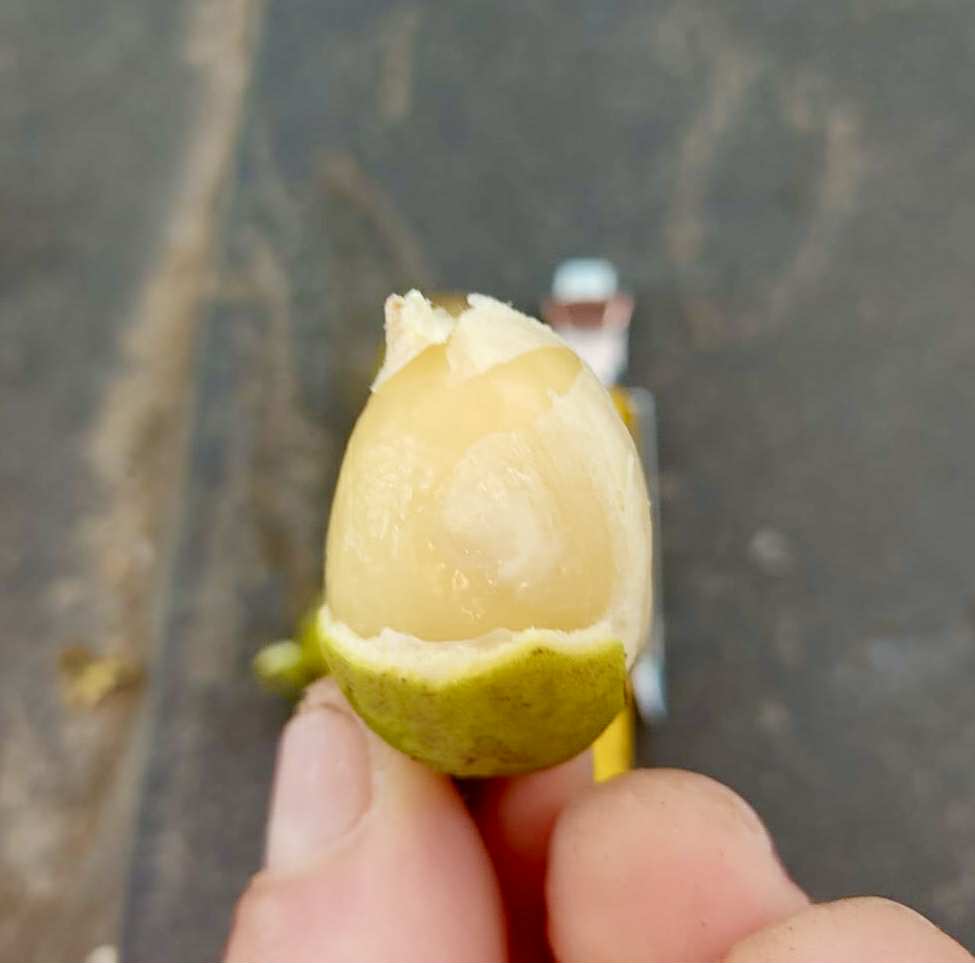
Family / Familie: Myrtaceaeorigin from / Herkunft: Brasil / Brasilien Climate / Klima: temperate to warm (15-30C / 59-86F) / gemäßigt bis warm (15-30C / 59-86F)Use / Verwendung: edible fruits, juice, jam, ice cream, etc. / essbare Früchte, Säfte, Marmelade, Eis usw.you buy / sie kaufen: 1 pottet seedling / 1 getopfter SämlingDelivery EU onlyThis Myrciaria does not yet have a scientific name and was found near the Myrciaria caerulescens.The leaves are similar to the leaves of the Blue Guaquiea but the fruits are completely different.The fruits have a sour-sweet taste.The tree stays small and can survive long dry periods.It grows slowly in the first two years.The location in Bahia is warm and there is a long dry period every year.The soil is iron-rich and has a lot of quartz sand in its composition.Please overwinter this Myrciaria at a minimum of 15 degrees.Diese Myrciaria hat noch keinen wissenschaftlichen Namen und wurde in der Nähe der Myrciaria caerulescens gefunden.Die Blätter ähneln den Blättern der Blue Guaquiea aber die Früchte sind völlig unterschiedlich.Die saftigen Früchte haben einen angenehmen sauer-süßen Geschmack.Der Baum bleibt klein und kann längere Trockenzeiten überstehen.Er wächst in den ersten zwei Jahren langsam.Am Standort in Bahia ist es warm und es gibt jährlich eine längere Trockenzeit.Die Erde ist eisenhaltig und hat viel Quarzsand in der Zusammensetzung.Diese Myrciaria bitte bei mindestens 15 Grad überwintern.
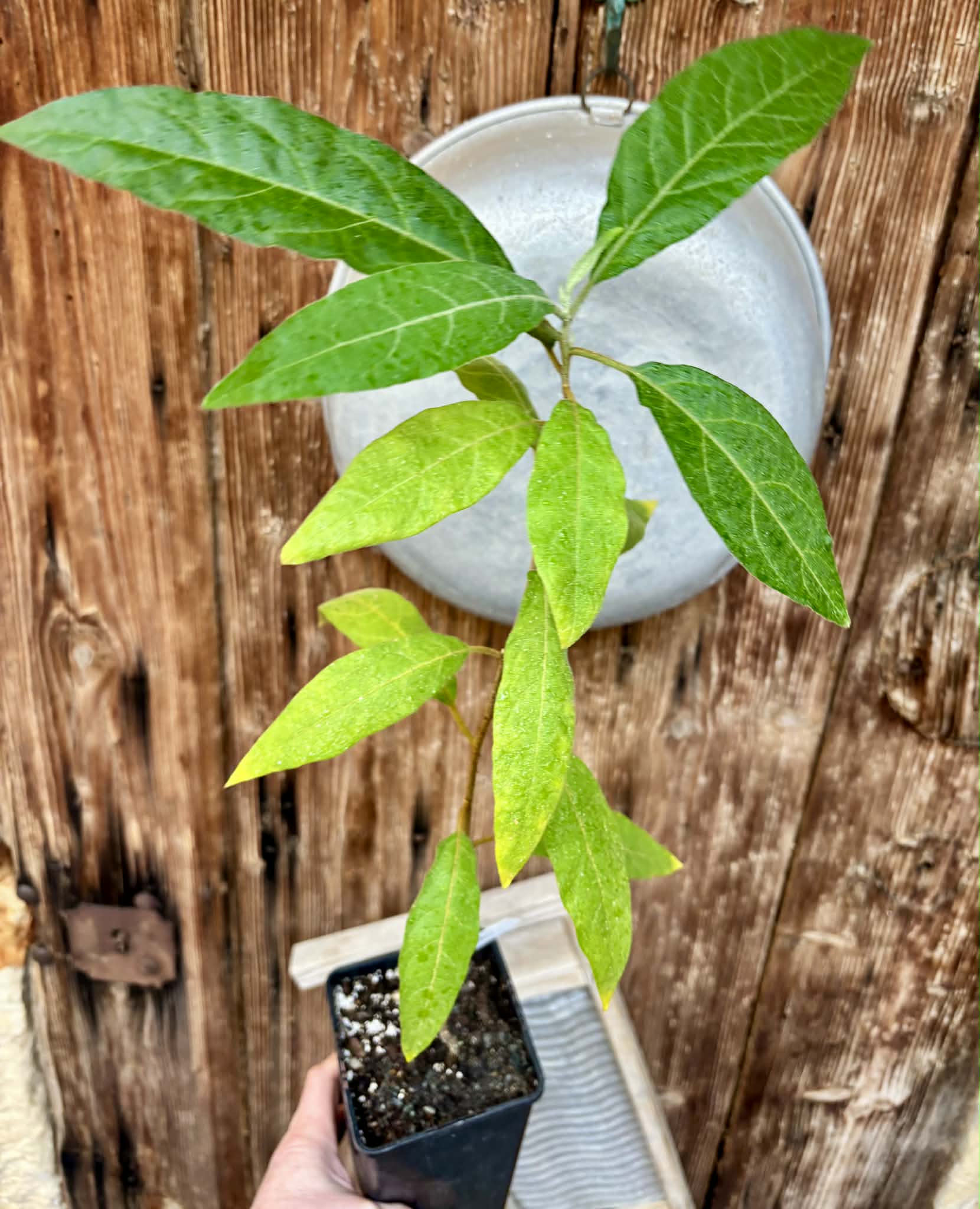
Eugenia sp Abacate
Family / Familie: Myrtaceaeorigin from / Herkunft: Brasilien Climate / Klima: temperate to warm (15-30C / 59-86F) / gemäßigt bis warm (15-30C / 59-86F)Use / Verwendung: edible fruits, juice, jam, ice cream, etc. / essbare Früchte, Säfte, Marmelade, Eis usw.you buy / sie kaufen: 1 potted seedling / 1 getopfter Sämling
Delivery EU only
Eugenia sp. Abacate – Exotic Treasure with Avocado AppealA Remarkable New Discovery from Bahia, Brazil
Eugenia sp. Abacate is a recently discovered, yet not fully classified species from the UNA National Park in Bahia, Brazil. What makes this species stand out is the distinct avocado-like shape of its fruit – hence the name “Abacate,” which means “avocado” in Portuguese.
Vibrant Fruits with Tropical Flavor
Shape & Size: Large, avocado-shaped fruits – unusual for the Eugenia genus
Pulp: Bright orange, juicy, and deliciously sweet
Skin: Thin with a slight astringent touch, adding depth to the flavor
Uses: Perfect for fresh snacking, and excellent for juices, jams, and desserts
This fruit’s combination of bold flavor, juiciness, and vivid color makes it a true delicacy and a collector’s delight.
Growth & Cultivation
Growth Habit: Medium-sized tree – great for container cultivation
Light: Prefers a bright, warm location
Temperature: Should be kept at no less than 15°C (59°F) during winter
Soil: Loose, well-draining, and rich in nutrients
Watering: Regular moisture without waterlogging
Rare and Desirable for Tropical Fruit Enthusiasts
Eugenia sp. Abacate is a botanical rarity with outstanding fruit quality. For collectors, tropical plant lovers, or experimental gardeners, this species offers something truly extraordinary and unique.
Eugenia sp. Abacate – sweet, tropical, and one-of-a-kind.Eugenia sp. Abacate – Tropenjuwel mit Avocado-CharmeEine spektakuläre Neuentdeckung aus Bahia
Die bislang wissenschaftlich noch nicht vollständig klassifizierte Eugenia sp. Abacate stammt aus dem UNA-Nationalpark im brasilianischen Bundesstaat Bahia. Diese außergewöhnliche Eugenia fällt nicht nur durch ihre Herkunft, sondern vor allem durch ihre außergewöhnlich geformten Früchte auf: Sie erinnern in Form und Größe an eine Avocado – daher der portugiesische Name „Abacate“.
Exotische Früchte mit intensiver Farbe und Geschmack
Fruchtform: Avocado-ähnlich – eine echte Rarität unter den Eugenien
Fruchtfleisch: Leuchtend orange, saftig und angenehm süß
Schale: Dünn mit einer leichten Adstringenz, die dem Geschmack Tiefe verleiht
Verwendung: Ideal roh genossen, aber auch perfekt für Säfte, Marmeladen und Desserts
Diese Früchte vereinen aromatische Intensität mit exotischem Flair – eine echte Bereicherung für Sammler und Feinschmecker tropischer Früchte.
Wuchsverhalten & Pflege
Wuchsform: Mittelgroßer Baum – geeignet für Topfkultur in gemäßigten Klimazonen
Licht: Heller, warmer Standort – ideal für gesundes Wachstum
Temperatur: Überwinterung bei mindestens 15 °C empfohlen
Substrat: Locker, nährstoffreich und gut durchlässig
Wasser: Gleichmäßige Feuchtigkeit, aber Staunässe vermeiden
Für Sammler und Liebhaber tropischer Vielfalt
Die Eugenia sp. Abacate ist nicht nur botanisch spannend, sondern auch kulinarisch faszinierend. Wer das Besondere sucht und eine einzigartige Eugenia mit großem Fruchtpotenzial kultivieren möchte, findet in ihr einen echten Geheimtipp.
Eugenia sp. Abacate – exotisch, aromatisch, außergewöhnlich.
Garcinia spruceana (Bacupari-miúdo)Family / Familie: Clusaceae origin from / Herkunft: Brasil / BrasilienClimate / Klima: temperate to warm (10-30C / 50-86F) / gemäßigt bis warm (10-30C / 50-86F)Use / Verwendung: edible fruits, juice, jam, ice cream, etc. / essbare Früchte, Säfte, Marmelade, Eis usw.you buy / sie kaufen: 1 fresh seed / 1 frischer SamenDelivery worldwide
Pre-order - these fresh seeds will be delivered at the beginning of May.Amazonian Rarity: Garcinia spruceana (Bacupari-miúdo)Garcinia spruceana is an extraordinary botanical gem from the heart of the Amazon, highly valued by connoisseurs for its vibrant yellow to orange fruits.Its local name "Bacupari-miúdo" refers to the compact size of the fruit, which nevertheless rivals its larger relatives in terms of flavor.The pulp features a snow-white, almost jelly-like consistency and offers a perfect balance between delicate sweetness and a subtle, refreshing tartness.In its native Brazil, the fruit is traditionally enjoyed fresh from the tree or processed into premium juices and dessert specialties.The tree impresses with its elegant pyramidal growth habit and decorative leathery leaves, making it a very attractive specimen even without fruit.Compared to other Garcinia species, spruceana is considered relatively vigorous and can produce its first blossoms within just a few years under optimal conditions.The species is known for its resilience to varying moisture conditions and has proven to be remarkably adaptable in cultivation.Due to its compact and steady growth in the early years, it is an ideal candidate for long-term container gardening on terraces or in conservatories.Traditionally, extracts from the plant are valued in local folk medicine for their anti-inflammatory properties, further highlighting the botanical significance of this species.As a purely tropical species, a bright and warm overwintering at temperatures of at least 12 to 15 degrees Celsius (54 to 59 degrees Fahrenheit) is recommended.This is a pre-order, as the fresh seeds will not be delivered until the beginning of May. Since the seeds are reserved specifically for you, the "Additional Order" option is not available for this item.Please select the standard shipping costs of €4 within Germany or €8 for international shipping during checkout.Vorbestellung - die Lieferung dieser frischen Samen erfolgt Anfang Mai.Amazonas-Rarität: Garcinia spruceana (Bacupari-miúdo)Die Garcinia spruceana ist eine außergewöhnliche Myrtengewächs-Verwandte aus dem Herzen des Amazonas, die unter Kennern für ihre leuchtend gelben bis orangefarbenen Früchte geschätzt wird. Ihr lokaler Name „Bacupari-miúdo“ deutet auf die kompakte Größe der Früchte hin, die jedoch in Sachen Aroma ihren größeren Verwandten in nichts nachstehen. Das Fruchtfleisch ist von einer schneeweißen, fast geleeartigen Konsistenz und bietet eine perfekte Balance zwischen einer feinen Süße und einer dezenten, erfrischenden Säure. In ihrer Heimat Brasilien wird die Frucht traditionell direkt vom Baum genossen oder zu hochwertigen Säften und Dessert-Spezialitäten verarbeitet. Der Baum besticht durch seine elegante, pyramidenförmige Wuchsform und seine dekorativen, ledrigen Blätter, was ihn auch als Solitärpflanze sehr attraktiv macht. Im Vergleich zu anderen Garcinia-Arten gilt die spruceana als verhältnismäßig wüchsig und kann unter guten Bedingungen bereits nach wenigen Jahren die ersten Blüten ansetzen. Die Art ist für ihre Widerstandsfähigkeit gegenüber wechselnden Feuchtigkeitsbedingungen bekannt und hat sich in der Kultur als ausgesprochen anpassungsfähig erwiesen. Durch ihren kompakten und langsamen Wuchs in den ersten Jahren ist sie ein idealer Kandidat für die langfristige Haltung im Kübel auf der Terrasse oder im Wintergarten. Traditionell werden Extrakte der Pflanze in der lokalen Volksmedizin für ihre entzündungshemmenden Eigenschaften geschätzt, was den botanischen Wert dieser Spezies noch unterstreicht. Da es sich um eine rein tropische Art handelt, wird eine helle und warme Überwinterung bei Temperaturen von mindestens 10 bis 15 Grad Celsius empfohlen.Es handelt sich hierbei um eine Vorbestellung, da die Auslieferung der frischen Samen erst Anfang Mai erfolgt.Da die Samen frisch für dich reserviert werden, ist die Option "Zusatzbestellung" für diesen Artikel nicht verfügbar.Bitte wähle im Bestellvorgang die regulären Versandkosten von 4 EUR innerhalb Deutschlands bzw. 8 EUR für den internationalen Versand aus.
Garcinia sp ApostoloiFamily / Familie: Clusaceae origin from / Herkunft: Brasil / BrasilienClimate / Klima: temperate to warm (10-30C / 50-86F) / gemäßigt bis warm (10-30C / 50-86F)Use / Verwendung: edible fruits, juice, jam, ice cream, etc. / essbare Früchte, Säfte, Marmelade, Eis usw.you buy / sie kaufen: 1 fresh seed / 1 frischer SamenDelivery worldwide
Pre-order - these fresh seeds will be delivered at the beginning of May.This highly rare Garcinia species is one of the most exciting new finds from the remaining Atlantic Rainforest fragments in Brazil.The name "Apostoloi" is a tribute to the renowned plant collector Apostolo Lucas, who discovered this unique form in the state of Espírito Santo.Currently scientifically undescribed, this species is a highly sought-after gem for connoisseurs of rare Myrtaceae and Garcinias.The fruits are often larger and more distinctively shaped than those of the classic Bacupari, ripening to a vibrant yellow-orange.Taste-wise, Garcinia sp. Apostoloi impresses with an excellent balance of delicate sweetness and a subtle, refreshing tartness.The snow-white, juicy pulp separates easily from the seed and offers an intense, high-level tropical aroma.The tree grows naturally in a very aesthetic pyramidal shape, featuring large, leathery leaves of a deep green hue.Originating from subtropical coastal forests, the plant proves to be robust and relatively adaptable in cultivation.Like many of its relatives, it is ideally suited for container gardening, where its decorative growth remains a highlight even without fruit.For successful cultivation, a bright, warm location and frost-free overwintering at a minimum of 10 degrees Celsius (50 degrees Fahrenheit) are recommended.This is a pre-order, as the fresh seeds will not be delivered until the beginning of May. Since the seeds are reserved specifically for you, the "Additional Order" option is not available for this item.Please select the standard shipping costs of €4 within Germany or €8 for international shipping during checkout.Vorbestellung - die Lieferung dieser frischen Samen erfolgt Anfang Mai.Diese hochseltene Garcinia-Art ist eine der spannendsten Neuentdeckungen aus den verbliebenen Urwaldresten des brasilianischen Mata Atlântica.Der Name „Apostoloi“ ist eine Hommage an den renommierten Pflanzensammler Apostolo Lucas, der diese besondere Form in Espírito Santo aufspürte.Wissenschaftlich ist diese Art noch unbeschrieben, was sie zu einem begehrten Sammlerstück für Kenner seltener Myrtengewächse und Garcinias macht.Die Früchte sind oft etwas größer und markanter geformt als die der klassischen Bacupari und reifen zu einem leuchtenden Gelb-Orange heran.Geschmacklich überzeugt die Garcinia sp. Apostoloi durch eine exzellente Balance aus feiner Süße und einer dezenten, erfrischenden Säure.Das schneeweiße, saftige Fruchtfleisch lässt sich leicht vom Samen lösen und bietet ein intensives, tropisches Aroma auf höchstem Niveau.Der Baum wächst von Natur aus sehr ästhetisch mit einer pyramidenförmigen Krone und trägt große, ledrige Blätter von tiefgründiger Farbe.Aufgrund ihrer Herkunft aus den subtropischen Küstenwäldern zeigt sich die Pflanze in der Kultur als robust und verhältnismäßig anpassungsfähig.Wie viele ihrer Verwandten eignet sie sich hervorragend für die Haltung im Kübel, wo sie durch ihren dekorativen Wuchs auch ohne Früchte besticht.Für eine erfolgreiche Kultur wird ein heller, warmer Standort und eine frostfreie Überwinterung bei mindestens 10 Grad Celsius empfohlen.Es handelt sich hierbei um eine Vorbestellung, da die Auslieferung der frischen Samen erst Anfang Mai erfolgt.Da die Samen frisch für dich reserviert werden, ist die Option "Zusatzbestellung" für diesen Artikel nicht verfügbar.Bitte wähle im Bestellvorgang die regulären Versandkosten von 4 EUR innerhalb Deutschlands bzw. 8 EUR für den internationalen Versand aus.
Cathedra sp Rondonia
Family / Familie: Aptandraceaeorigin from / Herkunft: Brasil / Brasilien Climate / Klima: temperate to warm (10-25C / 50-77F) / gemäßigt bis warm (10-25C / 50-77F)Use / Verwendung: juice, jam, ice cream, etc. / Säfte, Marmelade, Eis usw.you buy / sie kaufen: 1 germinated seed / 1 gekeimter Samen
Delivery worldwideA mysterious gem from the forests of Rondônia
Cathedra sp. Rondonia is an extremely rare fruit from the equally rare genus Cathedra and belongs to the Aptandraceae family. It grows in the Brazilian state of Rondônia, specifically in the Rio Branco region, which is inhabited by the indigenous Tupari people. This remote area, with its pristine nature and water-filled landscapes, provides the perfect environment for this hidden botanical treasure.
The fruit is particularly cherished by the Tupari community, as it is incredibly delicious and plays a vital role in their diet.
A taste and aroma experience
Taste: The fruit is very sweet, aromatic, and reminiscent of a blend of mango, starfruit, and water apple. The flavor is unmistakable, with floral undertones that bring to mind the Tucumán ice cream flavor.
Aroma: Upon opening the fruit, a strong floral fragrance emerges, enhancing the overall taste experience and tantalizing the senses.
Unique harvesting process
The Cathedra sp. Rondonia grows directly by the Rio Branco river, and harvesting requires approaching the tree by boat, as the fruit is picked right from the water's edge. This fascinating and almost mystical harvesting process adds to the allure of this rare plant.
Cultivation and care
Temperature: The plant likely thrives in warm, humid conditions and can withstand short flooding, as it grows naturally in tropical environments.
Overwintering: This plant should be overwintered at a minimum of 15°C.
Location: An ideal spot would offer warm, humid conditions similar to a tropical rainforest, to best replicate its native environment.
Key features at a glance
Origin: Rondônia, Brazil – Rio Branco region
Fruit: Very sweet, aromatic, with a floral aroma
Harvesting: Must be harvested by boat directly from the tree
Botanical significance: An extremely rare plant from the genus Cathedra and the Aptandraceae family
Cathedra sp. Rondonia is a botanical rarity that impresses not only with its exotic origin and fascinating harvesting process but also with its unique taste, which captivates the senses. A perfect choice for collectors and plant enthusiasts seeking something truly special.
Ein geheimnisvolles Juwel aus den Wäldern von Rondônia
Die Cathedra sp. Rondonia ist eine extrem seltene Frucht der ebenso seltenen Gattung Cathedra und gehört zur Familie der Aptandraceae. Sie wächst im brasilianischen Bundesstaat Rondônia, genauer gesagt im Gebiet des Rio Branco, das von den indigenen Tupari bewohnt wird. Diese Region ist mit ihrer unberührten Natur und den abgelegenen Gewässern der perfekte Standort für diesen geheimen botanischen Schatz.
Die Frucht ist besonders für die Tupari-Gemeinschaft von großer Bedeutung, da sie äußerst köstlich und ein wichtiger Bestandteil ihrer Ernährung ist.
Geschmackserlebnis und Aroma
Geschmack: Die Frucht ist sehr süß, aromatisch und erinnert an eine Kombination aus Mango, Karambola und Wasserapfel. Der Geschmack ist unverwechselbar, mit einer floralen Note, die an die Eissorte Tucumán erinnert.
Aroma: Beim Öffnen der Frucht entfaltet sich ein intensiver, blumiger Duft, der den Geschmack nur noch verstärkt und die Sinne betört.
Einzigartige Ernte
Die Cathedra sp. Rondonia wächst in unmittelbarer Nähe des Rio Branco und muss vom Boot aus geerntet werden, da der Baum direkt am Wasser wächst. Die Früchte werden sorgfältig vom Boot aus gepflückt – ein faszinierendes, fast mystisches Ernteverfahren.
Kultur und Pflege
Temperatur: Es wird angenommen, dass die Pflanze warme, feuchte Bedingungen bevorzugt und kurze Überflutungen überstehen kann, da sie in einem tropischen Umfeld gedeiht.
Überwinterung: Die Pflanze sollte bei mindestens 15 Grad Celsius überwintert werden.
Standort: Ein warmer, feuchter Standort, der ähnliche Bedingungen wie der tropische Regenwald bietet, wäre ideal.
Besonderheiten auf einen Blick
Fundort: Rondonia, Brasilien – Region des Rio Branco
Frucht: Sehr süß, aromatisch, florales Aroma
Ernte: Muss vom Boot aus direkt vom Baum gepflückt werden
Botanische Bedeutung: Eine äußerst seltene Pflanze der Gattung Cathedra und der Familie der Aptandraceae
Cathedra sp. Rondonia ist eine botanische Rarität, die nicht nur durch ihre exotische Herkunft und den faszinierenden Ernteprozess besticht, sondern auch durch ihren einzigartigen Geschmack, der die Sinne verführt. Eine perfekte Wahl für Sammler und Pflanzenliebhaber, die das Besondere suchen.
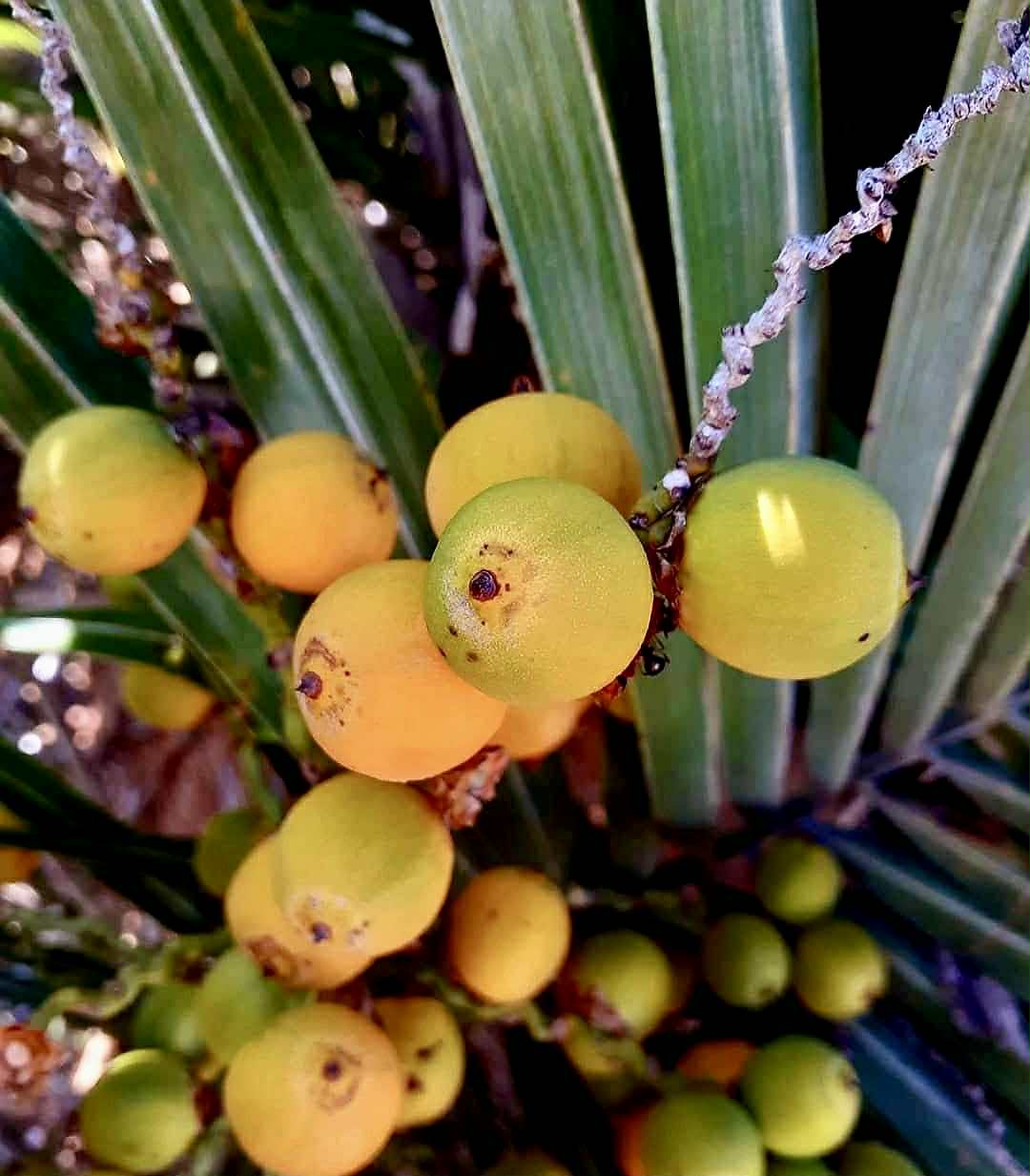
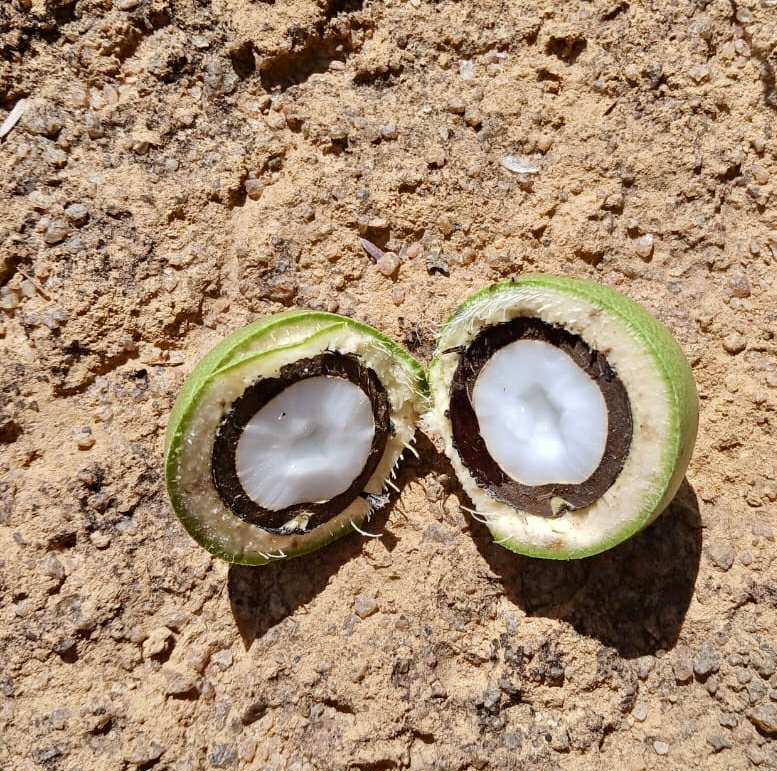
Coco de Raposa (Syagrus werdermannii)Family / Familie: Arecaceaeorigin from / Herkunft: Brasil / BrasilienClimate / Klima: temperate to warm (15-30C / 59-86F) / cold bis warm (15-30C / 59-86F)Use / Verwendung: edible fruits, juice, jam, ice cream, etc. / essbare Früchte, Säfte, Marmelade, Eis usw.you buy / sie kaufen: 1 germinated seed / 1 gekeimter SamenDelivery worldwideThe Syagrus werdermannii is one of the rarest palms on earth.It is found only in the municipality of Caetite in the Brazilian state of Bahia.There it grows in the savannas and survives long dry periods.This small palm grows to about 60 cm tall and produces edible, sweet fruits that taste like pequi.It requires a bright location during the growing season.In winter, it should be overwintered in a cool, bright place at a temperature of at least 10°C.Die Syagrus werdermannii gehört zu den seltensten Palmen dieser Erde.Sie kommt nur in der Gemeinde Caetite des brasilianischen Bundestaates Bahia vor.Dort wächst sie in den Savannen und übersteht längere Trockenzeiten.Diese kleine Palme wird ca. 60cm groß und produziert essbare, süße Früchte die geschmacklich auch an Pequi erinnern.Sie benötigt einen hellen Standort während der Wachstumsphase. Im Winter sollte sie kühl und hell bei mindestens 10°C überwintert werden.
Sandpaper Vine (Petrea volubilis)
Family / Familie: Verbenaceaeorigin from / Herkunft: South America / SüdamerikaClimate / Klima: temperate (10-30C / 50-84F) / gemäßigt (10-30C / 50-84F) Use / Verwendung: ornament / medical - Zierde / medizinischyou buy / sie kaufen: 1 potted plant / 1 getopfte PflanzeDelivery EU onlyThis plant is already several years old and was grown from seed by us. It shed its leaves in winter and is just beginning to sprout new ones.Petrea volubilis, also known as Sandpaper Vine or Purple Wreath, is one of the most spectacular climbing plants in tropical flora.Its intense violet inflorescences reach a remarkable length and hang in cascading clusters, giving it a majestic appearance.Particularly characteristic are the rough, dark green leaves, whose texture resembles sandpaper and gave the plant its common name.In full bloom, Petrea volubilis is an absolute eye-catcher and is often referred to as the Wisteria of the tropics due to its similarity.The plant grows vigorously and becomes woody, making it an ideal choice for greening pergolas, fences, or sturdy climbing aids in a conservatory.Although originally from Central and South America, it proves to be surprisingly adaptable and floriferous in cultivation.In the traditional medicine of its Central and South American homeland, Petrea volubilis is highly valued, with extracts from the leaves and bark specifically used to treat inflammations, skin conditions, and to provide support for respiratory issues.A sunny to partially shaded location is essential to encourage the full splendor of the violet flower clusters.The soil should be well-draining, rich in organic matter, and kept consistently moist during the growing season.Petrea volubilis is not frost-hardy and requires a bright, protected spot during the cold season.The plant must be overwintered in a frost-free location at a temperature of at least 10 degrees Celsius.Diese Pflanze ist bereits mehrere Jahre alt und von uns aus Samen gezogen. Sie hat im Winter ihre Blätter abgeworfen und beginnt gerade neu auszutreiben.Die Petrea volubilis, auch bekannt als Sandpapierwein oder Purple Wreath, gehört zu den spektakulärsten Kletterpflanzen der tropischen Flora.Ihre intensiv violetten Blütenstände erreichen eine beachtliche Länge und hängen in kaskadenartigen Trauben herab, was ihr ein majestätisches Erscheinungsbild verleiht.Besonders charakteristisch sind die rauen, dunkelgrünen Blätter, deren Textur an Sandpapier erinnert und der Pflanze ihren volkstümlichen Namen verliehen hat.In voller Blüte ist die Petrea volubilis ein absoluter Blickfang und wird aufgrund ihrer Ähnlichkeit oft als der Blauregen der Tropen bezeichnet.Die Pflanze wächst kräftig und verholzend, was sie zu einer idealen Wahl für die Begrünung von Pergolen, Zäunen oder stabilen Rankhilfen im Wintergarten macht.Obwohl sie ursprünglich aus Mittel- und Südamerika stammt, erweist sie sich in der Kultur als überraschend anpassungsfähig und blühfreudig.In ihrer mittel- und südamerikanischen Heimat wird die Petrea volubilis in der Volksmedizin geschätzt, wobei insbesondere Auszüge aus den Blättern und der Rinde traditionell zur Behandlung von Entzündungen und Hautleiden sowie zur Unterstützung bei Atemwegsbeschwerden eingesetzt werden.Ein sonniger bis halbschattiger Standort ist essenziell, um die volle Pracht der violetten Blütenkörbe zu fördern.Der Boden sollte gut durchlässig, humos und während der Wachstumsphase gleichmäßig feucht gehalten werden.Die Petrea volubilis ist nicht frosthart und benötigt einen hellen, geschützten Platz während der kalten Jahreszeit.Die Pflanze muss frostfrei bei einer Temperatur von mindestens 10 Grad überwintert werden.
Coco de Raposa (Syagrus werdermannii)Family / Familie: Arecaceaeorigin from / Herkunft: Brasil / BrasilienClimate / Klima: temperate to warm (15-30C / 59-86F) / cold bis warm (15-30C / 59-86F)Use / Verwendung: edible fruits, juice, jam, ice cream, etc. / essbare Früchte, Säfte, Marmelade, Eis usw.you buy / sie kaufen: 1 potted plant / 1 getopfte PflanzeDelivery EU onlyThe Syagrus werdermannii is one of the rarest palms on earth.It is found only in the municipality of Caetite in the Brazilian state of Bahia.There it grows in the savannas and survives long dry periods.This small palm grows to about 60 cm tall and produces edible, sweet fruits that taste like pequi.It requires a bright location during the growing season.In winter, it should be overwintered in a cool, bright place at a temperature of at least 10°C.Die Syagrus werdermannii gehört zu den seltensten Palmen dieser Erde.Sie kommt nur in der Gemeinde Caetite des brasilianischen Bundestaates Bahia vor.Dort wächst sie in den Savannen und übersteht längere Trockenzeiten.Diese kleine Palme wird ca. 60cm groß und produziert essbare, süße Früchte die geschmacklich auch an Pequi erinnern.Sie benötigt einen hellen Standort während der Wachstumsphase. Im Winter sollte sie kühl und hell bei mindestens 10°C überwintert werden.
Psidium sp AporáFamily / Familie: Myrtaceaeorigin from / Herkunft: Brasil / BrasilienClimate / Klima: temperate (10-30C / 50-84F) / gemäßigt (10-30C / 50-84F) Use / Verwendung: edible fruits, juice, jam, ice cream, etc. / essbare Früchte, Säfte, Marmelade, Eis usw.you buy / sie kaufen: 1 germinated seed / 1 gekeimter SamenDelivery worldwideA new guava that looks like a Jaboticaba
Another discovery that astonishes experts.Plinia, Eugenia, Psidium, Blepharocalyx, Calycolpus, or Marliera?This tree was recently discovered in Aporá, in the Brazilian state of Bahia.At first glance, it appears to be a Jaboticaba. A second look suggests it could also be a cauliflorous Eugenia.Only the seeds provide the clue and reveal it to be a Psidium.There are already two different Psidiums that grow cauliflorously.This is the third cauliflorous Psidium and certainly the most beautiful of the three.The fruits, like all guavas, are edible and have a sweet-sour flavor.These fruits should always be allowed to ripen to develop more aroma and sweetness.This Psidium is ideal for growing in containers.During the first year, grow in partial shade and avoid waterlogging.Please overwinter in a frost-free place at a minimum temperature of 10°C.
Eine neue Guave die aussieht wie eine Jaboticaba
Wieder ein Fund, der die Fachwelt erstaunen lässt.
Plinia, Eugenia, Psidium, Blepharocalyx, Calycolpus oder Marliera?
Dieser Baum wurde vor kurzer Zeit in Aporá im brasilianischen Bundesstaat Bahia entdeckt.Auf den ersten Blick scheint es eine Jaboticaba zu sein. Der zweite Blick sagt es könnte auch eine kauliflore Eugenia sein.
Erst die Samen geben Aufschluss und sagen es ist eine Psidium.Es gibt bereits zwei verschiedene Psidium, die kauliflor wachsen.Dies hier ist die jetzt dritte kauliflore Psidium und mit Sicherheit auch die Schönste von den Dreien.Die Früchte sind wie alle Guaven essbar und haben einen sauer-süßen Geschmack.Diese Früchte sollte man immer ausreifen lassen damit sie mehr Aromatic und Süße entwickeln.Diese Psidium ist hervorragend für die Kübelhaltung geeignet.Im ersten Jahr halbschattig ziehen und Staunässe vermeiden.Bitte frostfrei bei mindestens 10 °C überwintern.
Inga vera
Family / Familie: Fabaceaeorigin from / Herkunft: South America / SüdamerikaClimate / Klima: temperate to warm (15-25C / 59-77F) / gemäßigt bis warm (15-25C / 59-77F)Use / Verwendung: edible fruits, juice, jam, ice cream, etc. / essbare Früchte, Säfte, Marmelade, Eis usw.you buy / sie kaufen: 1 potted seedling / 1 getopfter SämlingDelivery EU onlyThe rare Inga vera differs from the more familiar Inga edulis in its smaller fruits and its preferred habitat on riverbanks.Fruit & TasteAppearance: The fruits are green to yellowish-brown, longitudinally ribbed pods.Taste: The white, cottony pulp (aril) surrounding the seeds is juicy and sweet.It has the typical aroma of vanilla ice cream or cotton candy.Consumption: Only the white pulp is eaten raw. The dark seeds are inedible raw but can be eaten cooked.Cultivation & CareSince Inga vera is a subtropical plant, it must be kept in a container in Central Europe.Light & Heat: It requires a very bright, sunny location. As a subtropical tree, it thrives best at 15–30 °C (59–86 °F).It is sensitive to frost; temperatures below 0 °C (32 °F) cause damage, and below -2 °C (28 °F) the plant usually dies.Water requirements: Inga vera often grows along rivers in nature and therefore tolerates very wet soils at times (even short-term flooding), but should never dry out completely.Water regularly in summer, reduce moisture in winter.Soil: Ideally, use a nutrient-rich, loamy soil that is well-draining (e.g., mixed with sand or perlite) to prevent root rot in containers.Die seltene Inga vera unterscheidet sich von der bekannteren Inga edulis durch kleinere Früchte und ihren bevorzugten Lebensraum an Flussufern. Frucht & GeschmackAussehen: Die Früchte sind grüne bis gelb-braune, längs gerippte Hülsenfrüchte.Geschmack: Das weiße, watteähnliche Fruchtfleisch (Arillus) um die Samen ist saftig und süß. Es hat das typische Aroma nach Vanille-Eiscreme oder Zuckerwatte.Verzehr: Nur das weiße Fruchtfleisch wird roh gegessen. Die dunklen Samen sind roh ungenießbar, können aber gekocht verzehrt werden. Haltung & PflegeDa Inga vera eine subtropische Pflanze ist, muss sie in Mitteleuropa im Kübel gehalten werden. Licht & Wärme: Sie benötigt einen sehr hellen, vollsonnigen Platz. Als subtropischer Baum gedeiht sie am besten bei 15–30 °C. Sie ist frostempfindlich; Temperaturen unter 0 °C führen zu Schäden, unter -2 °C stirbt die Pflanze meist ab.Wasserbedarf: Inga vera wächst in der Natur oft an Flüssen und verträgt daher zeitweise sehr nasse Böden (sogar kurzzeitige Überschwemmungen), sollte aber nie ganz austrocknen. Im Sommer regelmäßig gießen, im Winter die Feuchtigkeit reduzieren.Boden: Ideal ist eine nährstoffreiche, lehmige Erde, die gut wasserdurchlässig ist (z. B. mit Sand oder Perlit gemischt), um Wurzelfäule im Kübel zu vermeiden.
Ecclinusa sp DoceFamily / Familie: Sapotaceaeorigin from / Herkunft: Brazil / BrasilienClimate / Klima: temperate to warm (15-30C / 59-86F) / gemäßigt bis warm (15-30C / 59-86F)Use / Verwendung: edible fruits, juice, jam, ice cream, etc. / essbare Früchte, Säfte, Marmelade, Eis usw.you buy / sie kaufen: 1 potted seedling / 1 getopfter Sämling
Delivery EU onlyEcclinusa is an extremely rare genus of the Sapotaceae family.This rare exotic fruit was discovered in the Amazon region of the Brazilian state of Rondônia, on the border with Bolivia.The fruit is very sweet and tastes similar to abiu with sweetened condensed milk.The tree is small and well-suited for growing in containers.In the first year, grow it in partial shade and avoid waterlogging.Please overwinter this plant at a minimum temperature of 15 degrees Celsius.Ecclinusa ist eine äußerst seltene Gattung der Sapotenfamilie.Gefunden wurde diese seltene Exotenfrucht im Amazonas des brasilianischen Bundesstaates Rondonia, an der Grenze zu Bolivien.Diese Frucht ist sehr süß und erinnert geschmacklich an Abiu mit gezuckerter Kondensmilch.Der Baum ist klein und gut für Kübelhaltung geeignet.Im ersten Jahr halbschattig ziehen und Staunässe vermeiden.Bitte diese Pflanze bei mindestens 15 Grad überwintern.
Inga velutina
Family / Familie: Fabaceaeorigin from / Herkunft: South America / SüdamerikaClimate / Klima: temperate to warm (15-25C / 59-77F) / gemäßigt bis warm (15-25C / 59-77F)Use / Verwendung: edible fruits, juice, jam, ice cream, etc. / essbare Früchte, Säfte, Marmelade, Eis usw.you buy / sie kaufen: 1 potted seedling / 1 getopfter SämlingDelivery EU onlyInga velutina is a very rare species within the genus Inga.The fruit is edible and closely resembles other Inga species, such as the more familiar "ice cream bean" (Inga edulis).The edible pulp (aril) surrounding the seeds has a sweet, cottony texture.It is often described as mild and refreshing, similar to a blend of vanilla and melon.It is typically eaten raw.Growing Inga velutina as an ornamental or fruit tree requires a subtropical climate and specific conditions.The tree needs a sunny to partially shaded location.It should be sheltered from strong winds.Inga velutina thrives best in warm temperatures.It is not frost-tolerant and should be overwintered in a protected location if temperatures drop below 10°C (or 0°C for short periods).In colder regions, it is advisable to keep the plant in a greenhouse or as a container plant, overwintering it indoors.The plant prefers well-drained, fertile soil rich in organic matter.A slightly acidic to neutral pH (5.5–7.0) is ideal. Waterlogging must be strictly avoided.The soil should be kept consistently moist, but not wet. Inga velutina requires moderate, consistent moisture, as it thrives in humid environments.Die Inga velutina ist eine sehr seltene Species innerhalb der Gattung Inga.Die Frucht ist essbar und ähnelt sehr den anderen Inga-Arten, wie der bekannteren "Ice Cream Bean" (Inga edulis). Der Geschmack des essbaren Fruchtfleischs (Arillus), das die Samen umgibt, ist süß und von wattiger Konsistenz. Er wird oft als mild und erfrischend beschrieben, ähnlich wie eine Mischung aus Vanille und Melone.Es wird typischerweise roh gegessen. Die Haltung von Inga velutina als Zier- oder Obstbaum erfordert ein subtropisches Klima und spezielle Bedingungen.Der Baum benötigt einen sonnigen bis halbschattigen Standort.Er sollte vor starkem Wind geschützt sein.Inga velutina gedeiht am besten bei warmen Temperaturen.Sie ist nicht frosttolerant und sollte bei Temperaturen unter 10 °C (oder 0 °C kurzfristig) geschützt überwintert werden. In kälteren Regionen ist eine Haltung im Gewächshaus oder als Kübelpflanze mit Überwinterung im Haus ratsam.Die Pflanze bevorzugt gut durchlässigen, fruchtbaren Boden, der reich an organischer Substanz ist. Ein leicht saurer bis neutraler pH-Wert (5,5–7,0) ist ideal. Staunässe muss unbedingt vermieden werden.Der Boden sollte konstant feucht, aber nicht nass gehalten werden. Inga velutina benötigt eine moderate, gleichmäßige Feuchtigkeit, da sie in humiden Umgebungen gedeiht.
Eugenia sp Ametista
Family / Familie: Myrtaceaeorigin from / Herkunft: Brasil / BrasilienClimate / Klima: temperate to warm (15-30C / 50-84F) / gemäßigt bis warm (15-30C / 50-84F)Use / Verwendung: edible fruits, juice, jam, ice cream, etc. / essbare Früchte, Säfte, Marmelade, Eis usw.you buy / sie kaufen: 1 potted seedling / 1 getopfter Sämling
Delivery EU onlyThis newly discovered Eugenia originates from the Mata Atlantica in Bahia, Brazil.The fruits, which are about 2cm in size, have a purple, juicy flesh. Hence the name Ametista – a reference to an amethyst.They are very juicy, and the taste is described as very sweet and aromatic.The tree is medium-sized and grows well in a pot.Grow in partial shade during the first year and avoid waterlogging.Please overwinter this plant at a minimum temperature of 15 degrees Celsius (59 degrees Fahrenheit).Diese neu entdeckte Eugenia stammt aus dem Mata Atlantica in Bahia - Brasilien.Die ca. 2cm großen Früchte haben ein violettes, saftiges Fruchtfleisch. Daher der Name Ametista - in Anspielung an einen AmethystenSie sind sehr saftig und der Geschmack wird sehr süß und aromatisch beschrieben.Der Baum ist mittelgroß und lässt sich gut im Topf halten.Im ersten Jahr halbschattig ziehen und Staunässe vermeiden.Bitte diese Pflanze bei mindestens 15 Grad überwintern.
Eugenia sp Essencia negraFamily / Familie: Myrtaceaeorigin from / Herkunft: Bahia (Brasil)Climate / Klima: temperate (15-30C / 59-84F) / gemäßigt (15-30C / 59-84F) Use / Verwendung: edible fruits, juice, jam, ice cream, etc. / essbare Früchte, Säfte, Marmelade, Eis usw.you buy / sie kaufen: 1 potted seedling / 1 getopfter SämlingDelivery EU onlyEugenia sp. "Essencia negra" is one of the most beautiful new discoveries from the Mata Atlantica in the state of Bahia, Brazil.Hardly any other Eugenia starts out as a seedling with a purple color.This color is absolutely stunning, and you can spot it from afar against the green grass.This Eugenia also impresses with its relatively large fruits and a very pleasant flavor.Not much can be said about its care and maintenance, as it was only recently discovered.We recommend avoiding waterlogging in the first year and growing it in partial shade.Please overwinter this rare Eugenia at a minimum temperature of 15 degrees Celsius.Die Eugenia sp. „Essencia negra“ ist eine der schönsten Neuentdeckungen aus dem Mata Atlantica im Bundesstaat Bahia, Brasilien.Kaum eine andere Eugenia startet mit einer violetten Farbe im Sämlingsalter.Diese Farbe ist absolut beeindruckend und man erkennt sie bereits von Weitem im grünen Gras.Diese Eugenia besticht auch durch relativ große Früchte mit einem sehr angenehmen Geschmack.Über die Pflege und Haltung kann man noch nicht viel berichten, da sie erst vor kurzer Zeit entdeckt wurde.Wir empfehlen im ersten Jahr Staunässe zu vermeiden und sie halbschattig zu ziehen.Diese seltene Eugenia bitte bei mindestens 15 Grad überwintern.
Cordiera sp JenipapoFamily / Familie: Rubiaceae origin from / Herkunft: Brasil / BrasilienClimate / Klima: temperate to warm (15-30C / 60-90F) / gemäßigt bis warm (15-30C / 60-90F) Use / Verwendung: edible fruits, juice, jam, ice cream, etc. / essbare Früchte, Säfte, Marmelade, Eis usw.you buy / sie kaufen: 1 potted seedling / 1 getopfter SämlingDelivery EU only
Here we have a very special treasure for collectors of extremely rare fruit plants.The first question was: is this a Melanopsidium or a Cordiera (similar to Cordiera rugosa)?Both plants belong to the Rubiaceae family, and this fruit appears to be either a Cordiera or a completely new species.The location is still being kept secret, but it is the Mata Atlantica that has once again revealed a treasure of nature.These fruits grow as large as an apple and have a truly delicious and tasty flavor.It is sweet and slightly tart. It is reminiscent of several exotic fruits, yet has something completely unique about it.The tree is not very large and is probably suitable for growing in a pot.There are probably only fewer than 10 trees of this rare species in the area.It is therefore an absolute rarity.We recommend growing this plant in partial shade during the first year and avoiding waterlogging.Please overwinter at a temperature of at least 15 degrees Celsius.Hier haben wir einen ganz besonderen Schatz für Sammler extremst seltener Fruchtpflanzen.Die erste Frage war: ist das eine Melanopsidium oder eher eine Cordiera (ähnlich der Cordiera rugosa)?Beide Pflanzen stammen aus der Familie der Rubiaceae und diese Frucht scheint eher eine Cordiera zu sein oder es handelt sich um eine völlig neue Art.Der Fundort wird noch geheim gehalten aber es ist der Mata Atlantica, der wieder einmal einen Schatz der Natur preisgibt.Diese Früchte werden groß wie ein Apfel und haben einen richtig guten und leckeren Geschmack.Er ist süß und leicht säuerlich. Er erinnert an mehrere exotische Früchte und hat dennoch etwas völlig eigenes.Der Baum ist nicht sehr groß und wahrscheinlich auch für einen Anbau im Topf geeignet.Von dieser seltenen Art gibt es wahrscheinlich nur unter 10 Bäumen am Standort.Es ist also eine absolute Rarität.Wir empfehlen diese Pflanze im ersten Jahr halbschattig zu ziehen und Staunässe zu vermeiden.Bitte bei mindestens 15 Grad überwintern.
Plinia sp Dandara
Family / Familie: Myrtaceaeorigin from / Herkunft: Brasil / Brasilien Climate / Klima: temperate to warm (10-30C / 50-86F) / gemäßigt bis warm (10-30C / 50-86F)Use / Verwendung: edible fruits, juice, jam, ice cream, etc. / essbare Früchte, Säfte, Marmelade, Eis usw.you buy / sie kaufen: 1 small potted seedling / 1 kleiner, getopfter Sämling
Delivery EU only
Plinia sp. Dandara – New Jaboticaba from Bahia
Description:This extraordinary Jaboticaba was discovered only this year in the Brazilian state of Bahia, making it a true rarity among Plinia species. The fruits of this new Plinia resemble Plinia phitrantha (ESALQ), while the leaves are similar to those of Plinia oblongata or Plinia coronata.
Special Features:
Fruits: The fruits have a fantastic, sweet flavor with white, juicy pulp containing one or two seeds.
Growth: This new species displays the typical appearance of Plinia with a beautiful growth form.
Rarity: A newly discovered Jaboticaba species that is a true treasure for collectors due to its unique fruits and origin from Bahia.
Care Instructions:
Overwinter at a minimum of 10°C (50°F).
A warm, bright location ensures healthy growth.
Plinia sp. Dandara – Neue Jaboticaba aus Bahia
Beschreibung:Diese außergewöhnliche Jaboticaba wurde erst in diesem Jahr im brasilianischen Bundesstaat Bahia entdeckt und stellt eine wahre Rarität unter den Plinia-Arten dar. Die Früchte dieser neuen Plinia erinnern an Plinia phitrantha (ESALQ), während die Blätter Ähnlichkeiten mit Plinia oblongata oder Plinia coronata aufweisen.
Besonderheiten:
Früchte: Die Früchte haben einen fantastischen, süßen Geschmack und ein weißes, saftiges Fruchtfleisch, das ein bis zwei Samen enthält.
Wuchs: Diese neue Art hat die charakteristische Erscheinung der Plinia mit einer wunderschönen Wuchsform.
Seltenheit: Eine neu entdeckte Jaboticaba-Art, die durch ihre einzigartigen Früchte und die Herkunft aus Bahia zu einem echten Sammlerschatz wird.
Pflegehinweis:
Überwinterung bei mindestens 10 °C erforderlich.
Ein warmer, hellerer Standort sorgt für gesundes Wachstum.
Melicoccus sp Bahia
Family / Familie: Sapindaceaeorigin from / Herkunft: Brasil / BrasilienClimate / Klima: temperate to warm (10-30C / 50-86F) / gemäßigt bis warm (10-30C / 50-86F)Use / Verwendung: edible fruits, juice, jam, ice cream, etc. / essbare Früchte, Säfte, Marmelade, Eis usw.you buy / sie kaufen: 1 potted seedling / 1 getopfter Sämling
Delivery EU onlyBetter than mamoncillo or lychee!This tree was discovered in the Mata Atlantica of Bahia.Ten different Melicoccus species are currently known.This is likely a new eleventh species.The fruits are the size of a lychee and have a fantastic flavor.Very juicy, sweet, and with a hint of honey.For the first year, please grow in partial shade and avoid waterlogging.Overwinter at a minimum temperature of 15 degrees Celsius (59 degrees Fahrenheit).Besser als Mamoncillo oder Litchi!Dieser Baum wurde im Mata Atlantica von Bahia entdeckt.Bisher sind 10 verschiedene Melicoccus bekannt.Hier handelt es sich wahrscheinlich um eine neue elfte Art.Die Früchte haben die Größe einer Litchi und einen fantastisch guten Geschmack.Sehr saftig, süß und mit einer Note von Honig.Im ersten Jahr bitte halbschattig ziehen und Staunässe vermeiden.Überwintern bitte bei mindestens 15 Grad.
Duguetia aff. lanceolata - Pindauva RoxaFamily / Familie: Annonaceae origin from / Herkunft: Brasil / Brasilien Climate / Klima: temperate to warm (10-30C / 50-86F) / gemäßigt bis warm (10-30C / 50-86F) Use / Verwendung: edible fruits, juice, jam, ice cream, etc. / essbare Früchte, Säfte, Marmelade, Eis usw.you buy / sie kaufen: 1 potted plant / 1 getopfte Pflanze Delivery EU onlyThis Duguetia was discovered by the famous Brazilian collector Helton Muniz and is very rare. This Duguetia is a botanical treasure.Externally, this Duguetia is similar to the Duguetia lanceolata. However, there are some huge differences that identify this plant as a new, distinct Duguetia.The tree remains smaller and has more elongated leaves than the lanceolata.The fruits become larger, sweeter and have a darker, almost black skin. Even the seeds are different - they are smaller and rounder.The fruits of this Duguetia are very tasty and last up to 10 days after harvest.Slow growing species in the first two years.Very suitable for keeping in a bucket.Please overwinter at at least 10 degrees, even if it can tolerate light frost for a short time later.Diese Duguetia ist eine Entdeckung des berühmten, brasilianischen Sammlers Helton Muniz und sehr selten. Diese Duguetia ist eine botanische Kostbarkeit.Rein äußerlich hat diese Duguetia Ähnlichkeit mit der Duguetia lanceolata. Es gibt aber einige enorme Unterschiede, die diese Pflanze als eine neue, eigenständige Duguetia identifiziert.Der Baum bleibt kleiner und bekommt länglichere Blätter als die lanceolata.Die Früchte werden größer, süßer und haben eine dunklere, fast schwarze Schale. Selbst die Samen unterscheiden sich - sie sind kleiner und runder.Die Früchte dieser Duguetia sind sehr lecker und bis zu 10 Tage nach der Ernte haltbar.Langsam wachsende Art in den ersten beiden Jahren.Sehr gut für eine Kübelhaltung geeignet.Bitte bei mindestens 10 Grad überwintern, auch wenn sie später kurzfristig leichten Frost verträgt.
Eugenia sp UnanaFamily / Familie: Myrtaceae origin from / Herkunft: Brasil / Brasilien Climate / Klima: temperate to warm (15-30C / 59-86F) / gemäßigt bis warm (15-30C / 59-86F)Use / Verwendung: edible fruits, juice, jam, ice cream, etc. / essbare Früchte, Säfte, Marmelade, Eis usw.you buy / sie kaufen: 1 potted seedling / 1 getopfter Sämling Delivery EU onlyEugenia sp. "Unana" – A Tropical Gem with Impressive FoliageStraight from the lush forests of Bahia, Brazil, this yet-to-be-identified Eugenia species is a true treasure for collectors of rare plants!At first glance, Eugenia sp. Unana captivates with its huge, up to 20 cm long leaves, giving it a striking, tropical appearance.Another delightful feature: the new growth emerges in vibrant red, often a sign that this Eugenia will become an especially beautiful and eye-catching specimen.After just a few years of care, this special plant will reward collectors with fruits measuring about 4 cm:The flesh is juicy, aromatic, and offers a wonderfully pleasant flavor.The seed inside is relatively large, typical for many vigorous and hardy Eugenia species.This Eugenia prefers a bright location but does not tolerate waterlogging.Please overwinter it frost-free at a minimum of 15 °C.Eugenia sp. "Unana" – Tropisches Juwel mit beeindruckenden Blättern
Direkt aus den üppigen Wäldern von Bahia, Brasilien stammt diese noch unbeschriebene Eugenia-Art – ein echter Schatz für Liebhaber besonderer Pflanzen!Schon auf den ersten Blick beeindruckt die Eugenia sp. Unana mit ihren riesigen, bis zu 20 cm langen Blättern – sie verleihen der Pflanze ein exotisches und prachtvolles Erscheinungsbild.Ein weiteres Highlight: Die jungen Austriebe erscheinen in leuchtendem Rot, ein sicheres Zeichen dafür, dass sich diese Eugenia zu einer besonders attraktiven Schönheit entwickeln wird.Nach wenigen Jahren belohnt die Pflanze den geduldigen Sammler mit etwa 4 cm großen Früchten:Das Fruchtfleisch ist saftig, aromatisch und bietet ein äußerst angenehmes Geschmackserlebnis.Der Samen in der Mitte ist etwas größer, was typisch für viele besonders robuste Eugenias ist.Die Eugenia sp. Unana liebt einen hellen Standort, mag jedoch keine Staunässe.Bitte frostfrei bei mindestens 15 °C überwintern.
Chrysophyllum januariense
Family / Familie: Sapotaceaeorigin from / Herkunft: Brasil / Brasilien Climate / Klima: temperate to warm (15-30C / 59-86F) / gemäßigt bis warm (15-30C / 59-86F)Use / Verwendung: edible fruits, juice, jam, ice cream, etc. / essbare Früchte, Säfte, Marmelade, Eis usw.you buy / sie kaufen: 1 potted seedling / 1 getopfter Sämling
Delivery EU onlyHoly moly, this fruit, which is known to be almost extinct, was recently rediscovered.It was considered extinct for almost 100 years!But wait. Let's start from the beginning:In 1869, the German botanist August Wilhelm Eichler (who died of leukemia at the age of 47) first described this fruit in his work Flora Brasiliensis.Then came the time of emptiness.The tree was not found for over 100 years and was considered extinct or "almost extinct".But in 1987 the tree was rediscovered in the municipality of Saquarema and in 1995 in the municipality of Cabo Frio.In each case in the Restingas of the state of Rio de Janeiro.The tree is still on the IUCN (International Union for Conservation of Nature) list as almost extinct.Are the fruits actually tasty?Yes, they are! Many fruits from the sapote family (especially Pouteria) have a rather dry pulp and are suitable for juices, ice cream, etc.Fruits of the Chrysophyllum species are rather juicy. This is known from Abiu and Star-Apple (Caimito).This fruit is as sweet as sugar and has a juicy pulp with the consistency of a white sapote.The tree does not grow very large and has typical Chrysophyllum leaves.What is typical about it?Very simple. The underside of these leaves is very different from the top of the leaves. Sometimes they shimmer gold and sometimes silver.Once again, an almost extinct species has been found and shows us that nature is beautiful.Please mix some sand into the soil, as this plant comes from the Restinga.Please overwinter at a temperature of at least 15 degrees.Holy Moly, vor kurzer Zeit wurde diese Frucht wieder gefunden, von der man weiß, dass sie fast ausgestorben ist.Sie galt für fast 100 Jahre als ausgestorben!Doch halt. Beginnen wir von vorn:1869 hat der deutsche Botaniker August Wilhelm Eichler (gestorben mit 47 Jahren an Leukämie) diese Frucht erstmals in seinem Werk Flora Brasiliensis beschrieben.Dann kam die Zeit der Leere.Über 100 Jahre wurde der Baum nicht mehr gefunden und galt als ausgestorben oder „fast ausgestorben“.Doch 1987 wurde der Baum in der Gemeinde Saquarema und 1995 in der Gemeinde Cabo Frio wieder entdeckt.Jeweils in den Restingas des Bundesstaates Rio de Janeiro.Der Baum steht noch immer in der IUCN Liste (International Union for Conservation of Nature) als fast ausgestorben.Sind die Früchte eigentlich lecker?Ja sind sie!Viele Früchte aus der Sapotenfamilie (vor allem Pouteria) haben ein eher trockenes Fruchtfleisch und eignen sich für Säfte, Eis usw.Früchte der Chrysophyllum Arten sind eher saftig. Man kennt das von Abiu und Star-Apple (Caimito).Diese Frucht hier ist zuckersüß und hat ein saftiges Fruchtfleisch von der Konsistenz einer Weißen Sapote.Der Baum wird nicht sehr groß und hat typische Chrysophyllum Blätter.Was ist denn da typisch?Ganz einfach. Die Unterseite dieser Blätter unterscheidet sich wesentlich von der Oberseite der Blätter. Manchmal schimmern sie gold und manchmal silbern.Wieder einmal ist eine fast ausgestorbene Art gefunden worden und zeigt uns, dass die Natur wunderschön ist.Bitte der Erde etwas Sand zumischen, da diese Pflanze aus der Restinga kommt.Überwintern bitte bei mindestens 15 Grad.
Solanum sp. Mata Escura
Family / Familie: Solanaceaeorigin from / Herkunft: Brasil / BrasilienClimate / Klima: temperate to warm (10-30C / 50-86F) / gemäßigt bis warm (10-30C / 50-86F)Use / Verwendung: edible fruits, juice, jam, ice cream, etc. / essbare Früchte, Säfte, Marmelade, Eis usw.you buy / sie kaufen: 1 potted plant / 1 getopfte PflanzeDelivery EU onlyThis unknown Solanum was found in the Mata Escura Nature Reserve in Brazil.It covers approximately 500 square kilometers and protects the remaining Atlantic Rainforest of Minas Gerais.he reserve is classified as an IUCN Category 1a protected area, meaning it is one of the "strict" nature reserves.This particular Solanum has not yet been identified.Inside, it resembles a passion fruit and has sweet and sour pulp.Please overwinter at a minimum temperature of 10 degrees Celsius.
Diese unbekannte Solanum hat man im Naturschutzreservat Mata Escura in Brasilien gefunden.Es ist ca. 500 Quadratkilometer groß und schützt den Rest des Atlantischen Regenwaldes von Minas Gerais.Das Schutzgebiet gilt als IUCN Schutzgebiet 1a und damit zu den "strengen" Naturschutzgebieten.Diese Solanum wurde noch nicht identifiziert.Innen ähnelt sie eher einer Passionsfrucht und hat süß-saures Fruchtfleisch.Überwintern bitte bei mindestens 10 Grad.
Plinia sp Pingo de Mel (Vilela A3)
Family / Familie: Myrtaceaeorigin from / Herkunft: Brasil / Brasilien Climate / Klima: temperate to warm (15-30C / 59-86F) / gemäßigt bis warm (15-30C / 59-86F)Use / Verwendung: edible fruits, juice, jam, ice cream, etc. / essbare Früchte, Säfte, Marmelade, Eis usw.you buy / sie kaufen: 1 potted seedling / 1 getopfter Sämling
Delivery EU only
Plinia sp. 'Pingo de Mel' – Honey Drop Jaboticaba
– Rare Variety with Exceptionally Sweet Fruits –
Plinia sp. 'Pingo de Mel', which means “Honey Drop” in Portuguese, is one of the sweetest and most sought-after Jaboticaba varieties. A true gem for collectors and lovers of exotic tropical fruits.
Fruit & Flavor:
Small, amber to honey-colored fruits
Incredibly sweet, with an intense, almost honey-like taste
Best enjoyed fresh off the tree, but also great for juices and desserts
A unique tropical flavor experience
Growth & Care:
Compact, slow-growing tree with ornamental appeal
Perfectly suited for container cultivation
Thrives in well-draining soil and prefers a bright, sheltered location
Climate & Cultivation:
Easy to grow and low-maintenance
Tolerates short cool periods, but not frost-hardy
Must be overwintered at a minimum of 10 °C (50 °F)
Reduce watering in winter; avoid waterlogging
Note to Buyers:This rare Jaboticaba is one of the sweetest varieties in the world – a true delicacy and a highlight for any tropical fruit collection. Once you taste it, you'll always want more!
Plinia sp. 'Pingo de Mel' – Honigtropfen-Jaboticaba
– Seltene Rarität mit unvergleichlich süßen Früchten –
Plinia sp. 'Pingo de Mel', was auf Portugiesisch „Honigtropfen“ bedeutet, ist eine besonders süße und seltene Jaboticaba-Art, die vor allem bei Sammlern und Liebhabern exotischer Früchte sehr begehrt ist.
Früchte & Geschmack:
Kleine, bernstein- bis honigfarbene Früchte
Extrem süß, mit einer intensiven, fast honigartigen Note
Frisch vom Baum ein echter Genuss
Ideal für den Frischverzehr, aber auch für Säfte und Desserts geeignet
Wuchs & Pflege:
Kompakter, langsam wachsender Baum mit hoher Zierwirkung
Eignet sich hervorragend für die Kübelhaltung
Liebt durchlässige Erde und einen hellen, geschützten Standort
Kultur & Klima:
Anspruchslos und robust
Verträgt kurze kühlere Perioden, aber nicht frosthart
Überwinterung bei mindestens 10 °C
Im Winter weniger gießen und Staunässe vermeiden
Hinweis für Käufer:Diese außergewöhnliche Jaboticaba ist eine der süßesten Sorten weltweit – eine echte Delikatesse und ein Highlight für jede Sammlung tropischer Obstgehölze. Wer sie einmal probiert hat, wird sie immer wieder genießen wollen!
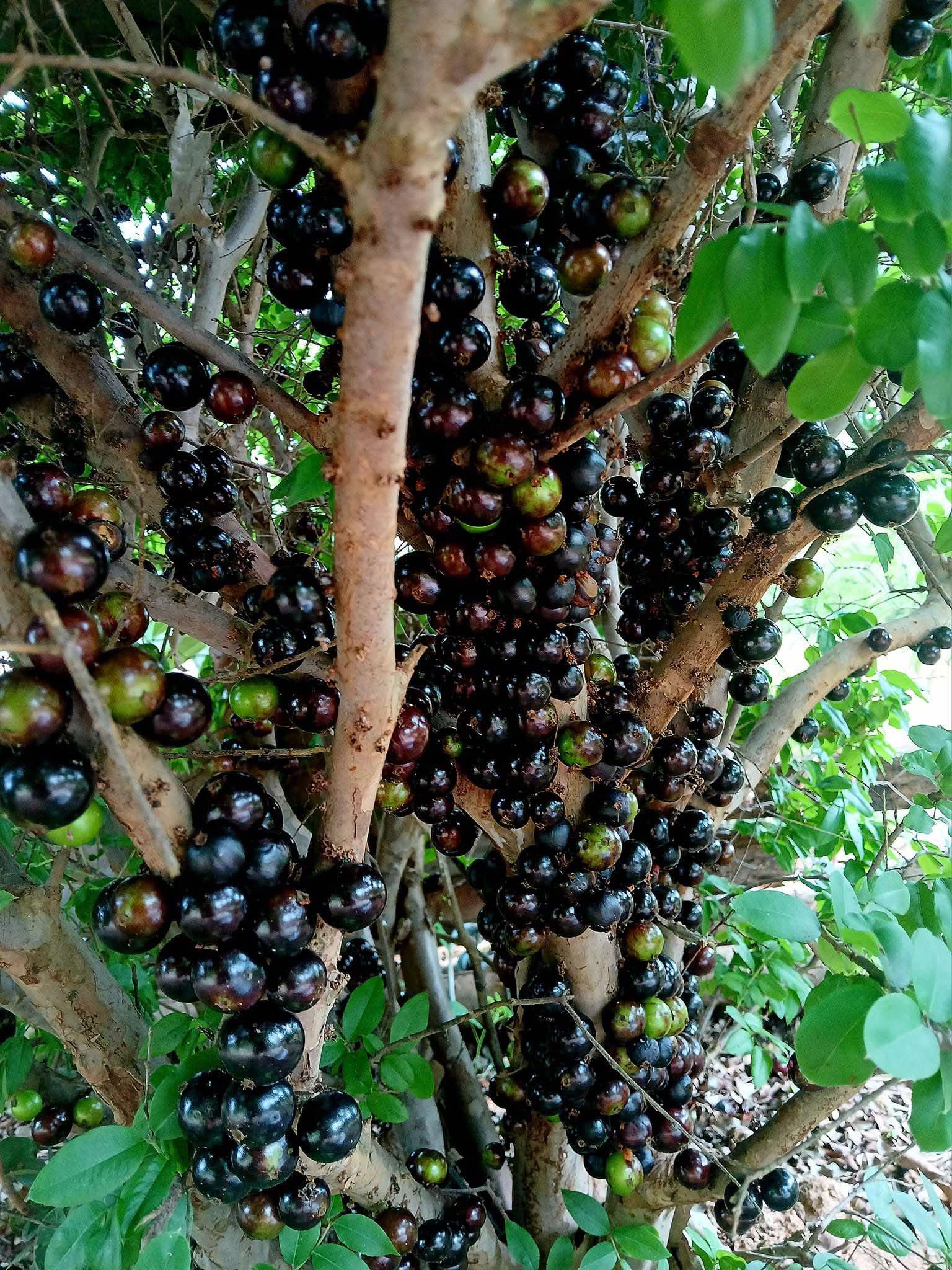
Jaboticaba - Plinia sp Esarme
Family / Familie: Myrtaceaeorigin from / Herkunft: Brasil / Brasilien Climate / Klima: temperate to warm (10-30C / 50-86F) / gemäßigt bis warm (10-30C / 50-86F)Use / Verwendung: edible fruits, juice, jam, ice cream, etc. / essbare Früchte, Säfte, Marmelade, Eis usw.you buy / sie kaufen: 1 potted seedling / 1 getopfter Sämling
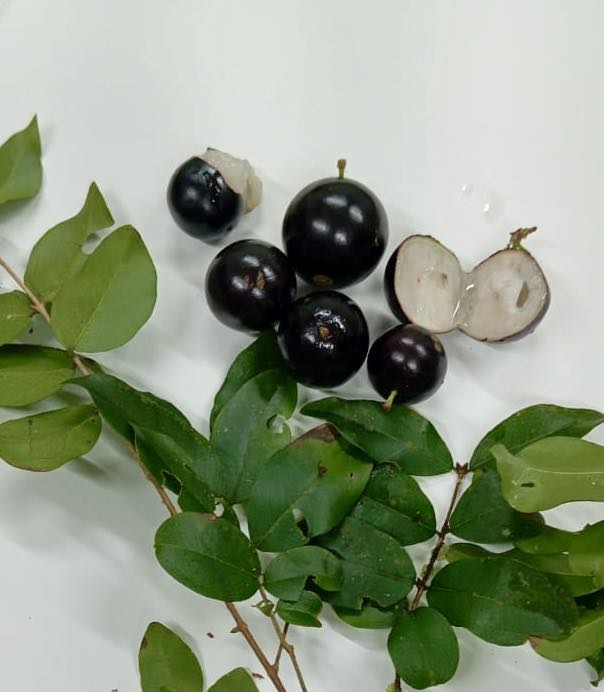
Delivery EU onlyThis Jaboticaba comes from Itabuna in Bahia Brazil.It looks like a mixture of Plinia oblongata and cauliflora.The fruits have white, very sweet and aromatic flesh.The skin is very thin and can be eaten.The seeds are germinated.In terms of taste, this Jabo gets 10 out of 10 points.Please overwinter this Jaboticaba at a minimum of 10 degrees.Diese Jaboticaba stammt aus Itabuna in Bahia Brasilien.Sie sieht aus wie eine Mischung aus Plinia oblongata und cauliflora.Die Früchte haben ein weißes, sehr süßes und aromatisches Fruchtfleisch.Die Schale ist sehr dünn und kann mitgegessen werden. Die Samen sind bereits gekeimt. Geschmacklich bekommt diese Jabo 10 von 10 Punkten.Bitte diese Jaboticaba bei mindestens 10 Grad überwintern.