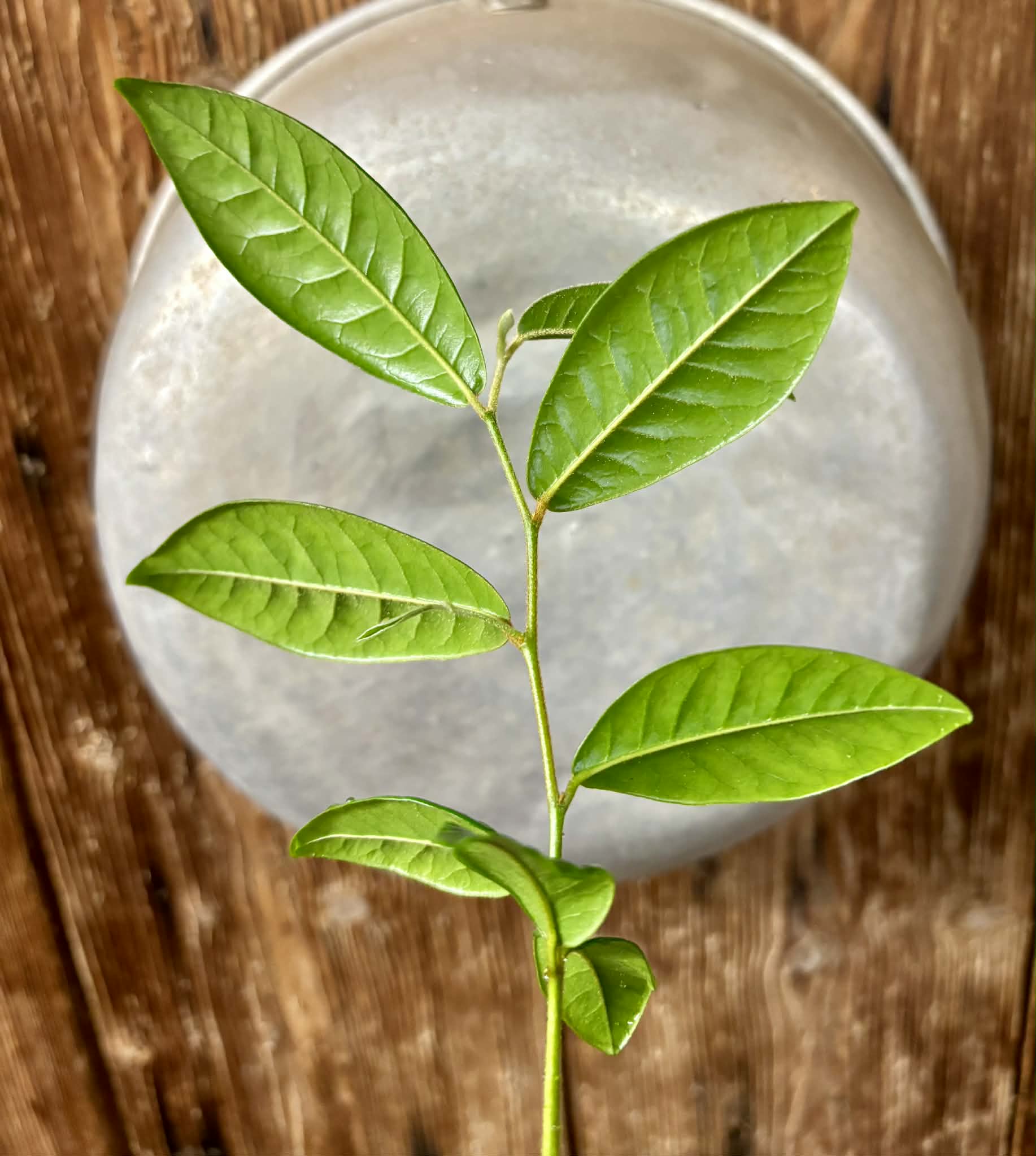
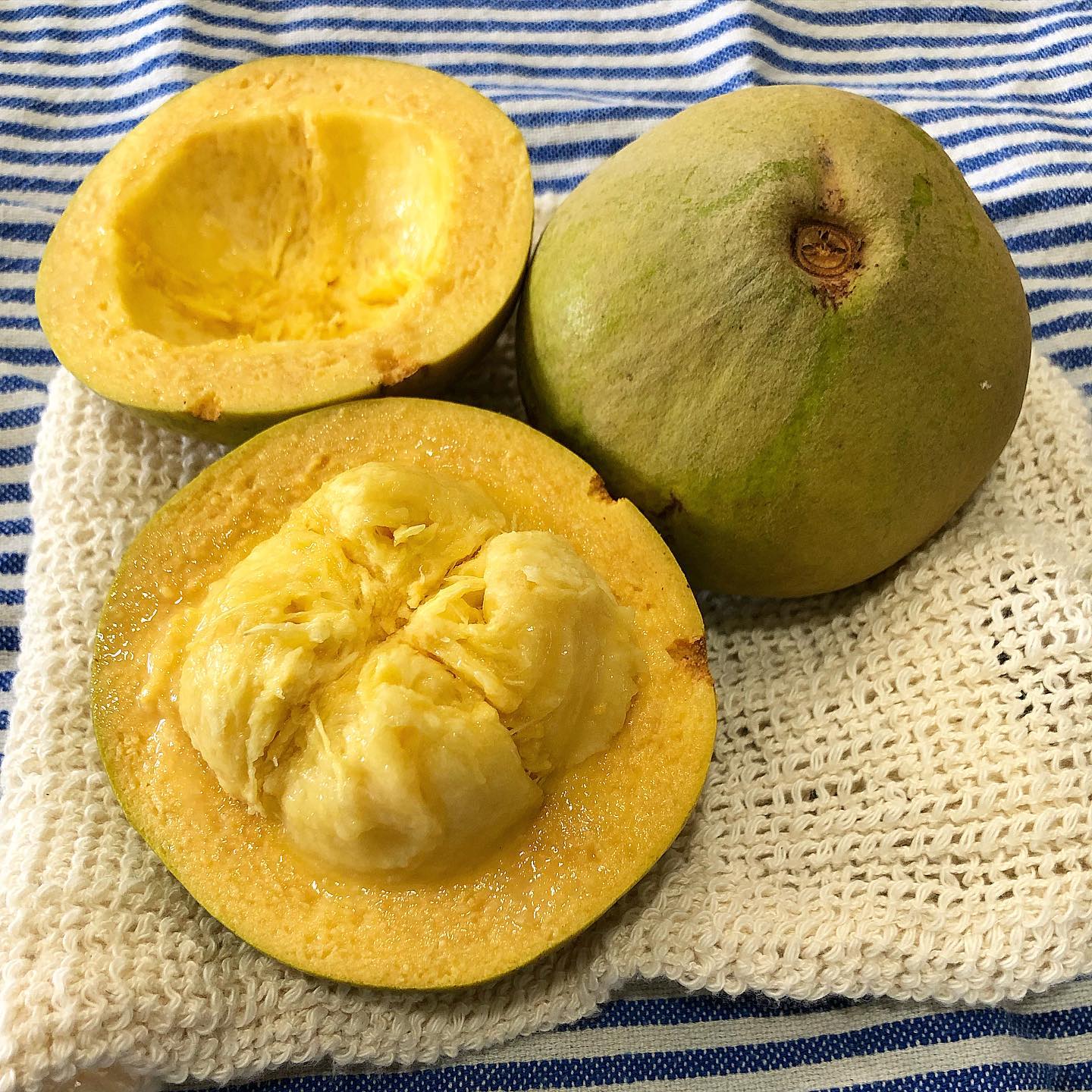
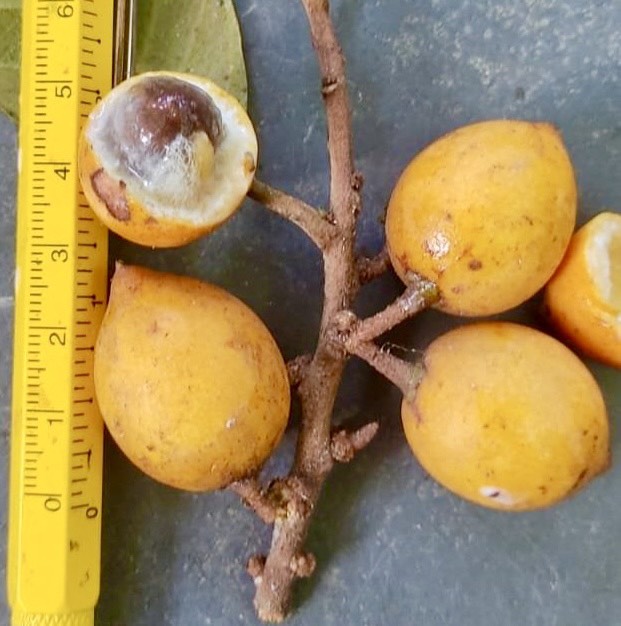
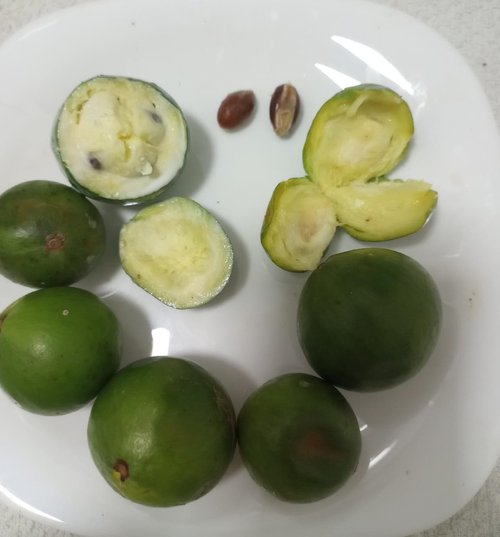
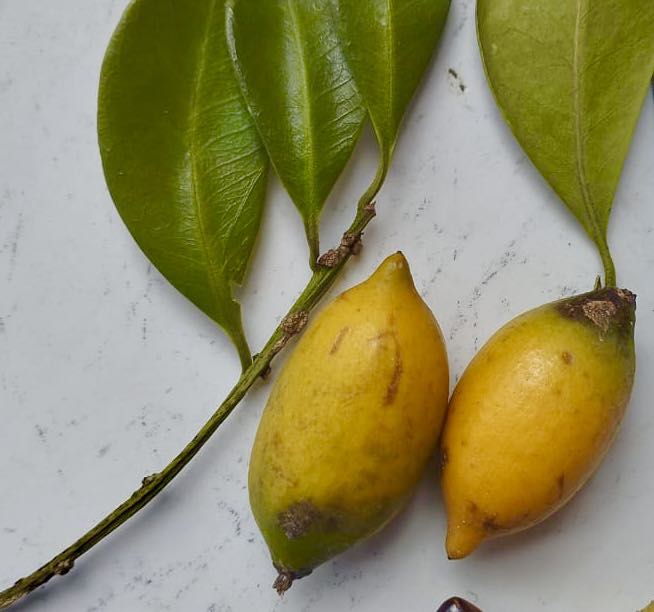
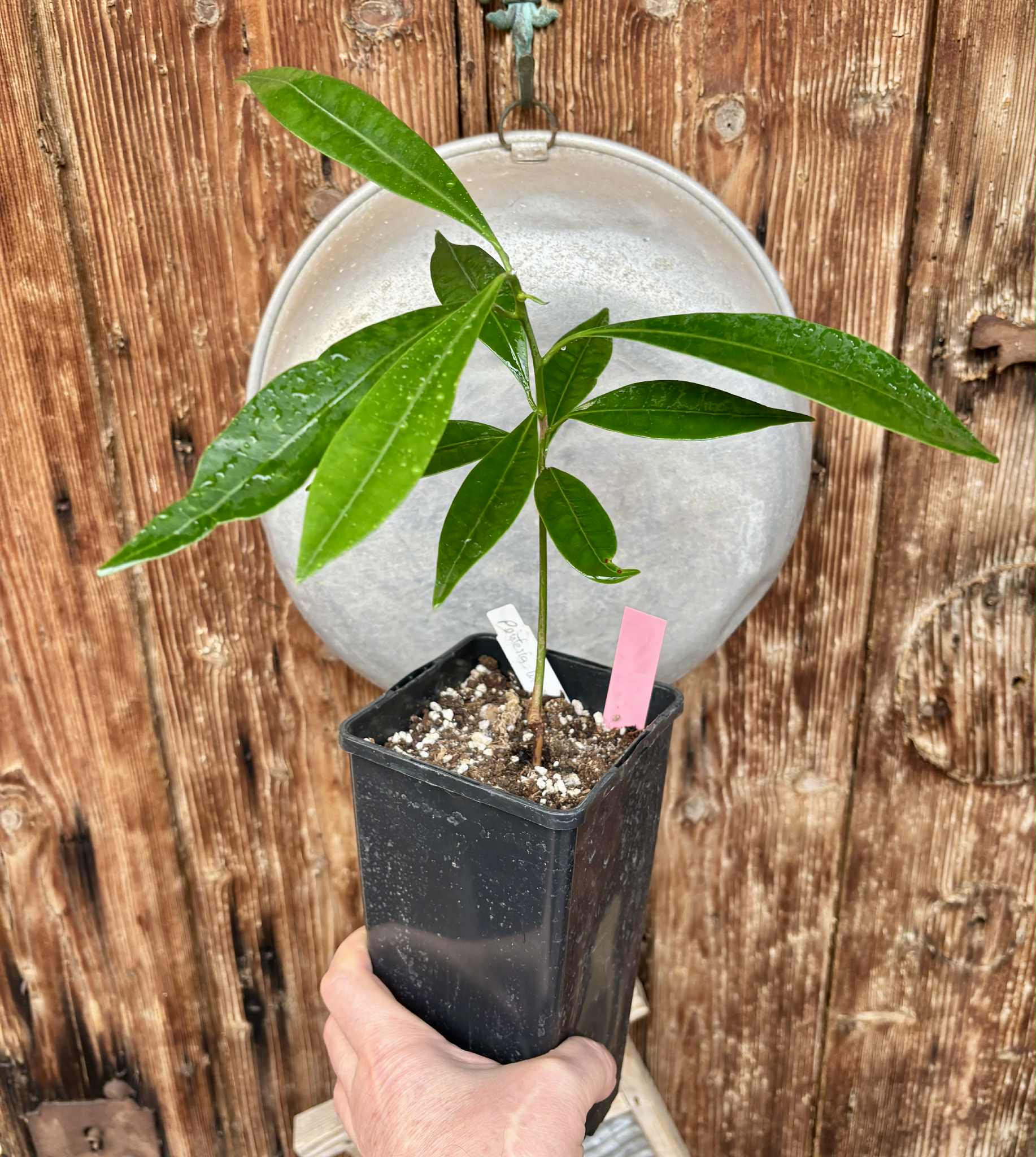
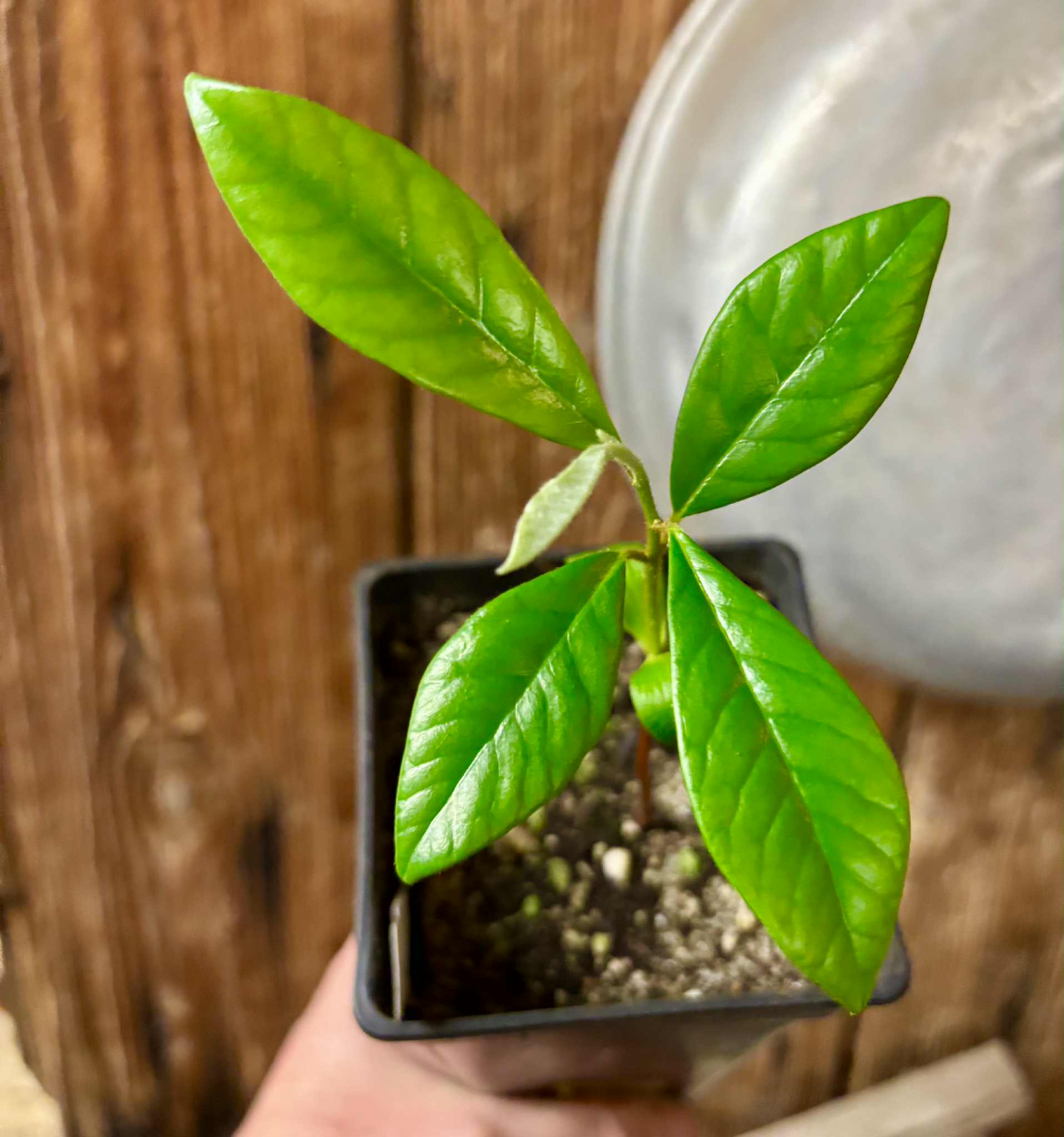
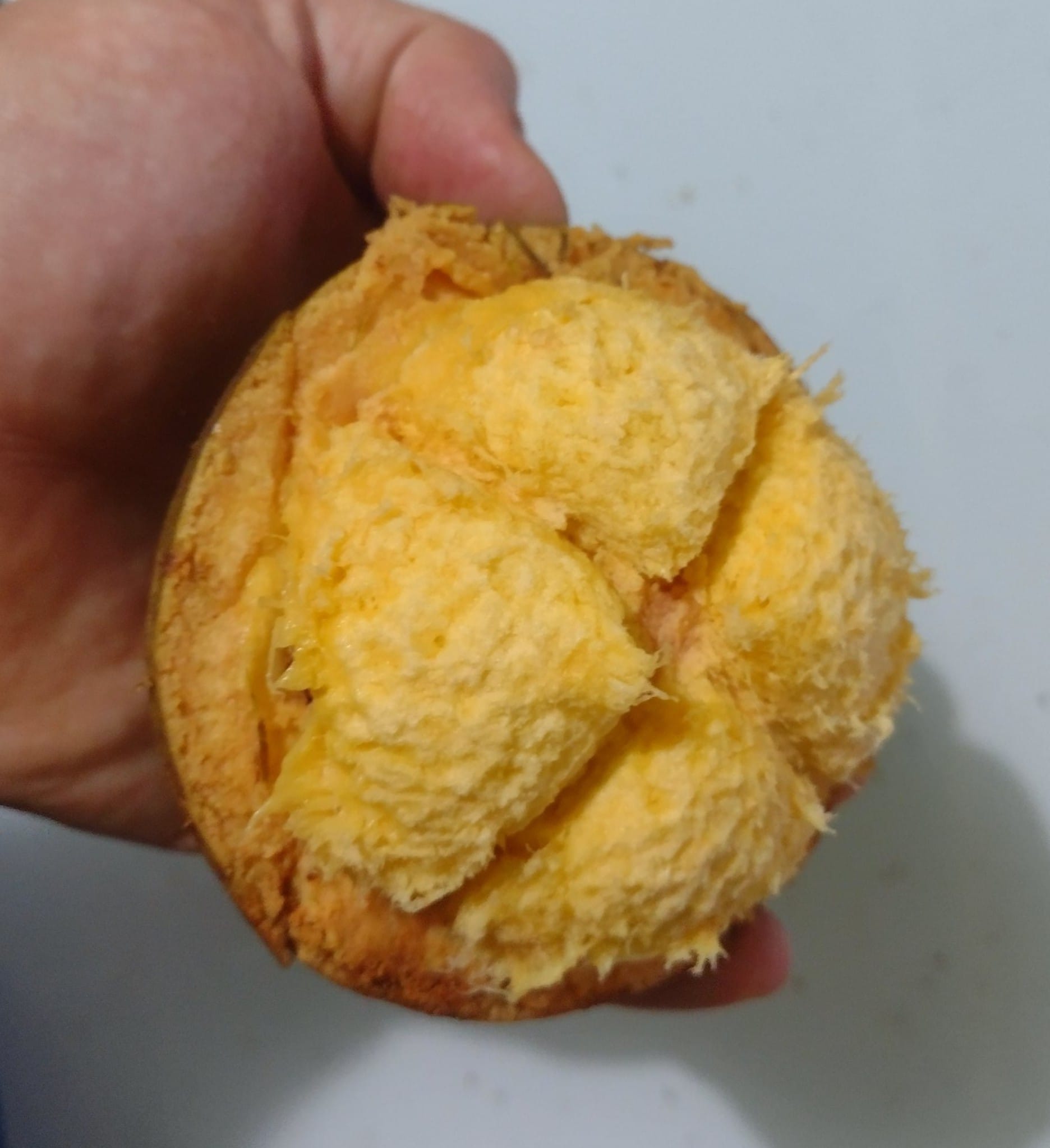
Abiu (Pouteria caimito)Family / Familie: Sapotaceae origin from / Herkunft: South America / Südamerika Climate / Klima: warm (15-30C / 60-77F) / warm (15-30C / 60-77F) Use / Verwendung: edible fruits, juice, jam, ice cream, etc. / essbare Früchte, Säfte, Marmelade, Eis usw.you buy / sie kaufen: 1 potted plant / 1 getopfte Pflanze Delivery EU onlyAbiu is a tropical fruit from the sapote family.The pulp is jelly-like, sweet and reminiscent of the taste of Caimito with a little caramel.The fruit is very good to eat fresh or to make into ice cream.Abiu fruits have a lot of calcium, phosphorus, vitamin A and vitamin C.The plant is grown in a similar way to cocoa.It loves it warm and humid.In the Amazon, they bloom for the first time after three years and several times a year.You can find flowers and ripe fruit on one tree at the same time.The trees will later have between 100 and 1000 fruits hanging on them.Please overwinter at a temperature of at least 15 degrees.Abiu ist eine tropische Frucht aus der Familie der Sapoten. Das Fruchtfleisch ist geleeartig, süß und erinnert an den Geschmack von Caimito mit etwas Karamell. Die Frucht lässt sich sehr gut frisch essen oder zu Eis zu verarbeiten. Abiu-Früchte haben viel Kalzium, Phosphor, Vitamin A und Vitamin C. Die Haltung der Pflanze ist ähnlich dem Kakao. Sie liebt es warm und feucht. Im Amazonas blühen sie nach drei Jahren das erste mal und mehrfach im Jahr. An einem Baum kann man Blüten und gleichzeitig reife Früchte finden. An diesen Bäumen hängen später zwischen 100 und 1000 Früchten. Bitte bei mindestens 15 Grad überwintern.
Abiu (Pouteria caimito)Family / Familie: Sapotaceae origin from / Herkunft: South America / Südamerika Climate / Klima: warm (15-30C / 60-77F) / warm (15-30C / 60-77F) Use / Verwendung: edible fruits, juice, jam, ice cream, etc. / essbare Früchte, Säfte, Marmelade, Eis usw.you buy / sie kaufen: 1 potted plant / 1 getopfte Pflanze Delivery EU onlyAbiu is a tropical fruit from the sapote family.The pulp is jelly-like, sweet and reminiscent of the taste of Caimito with a little caramel.The fruit is very good to eat fresh or to make into ice cream.Abiu fruits have a lot of calcium, phosphorus, vitamin A and vitamin C.The plant is grown in a similar way to cocoa.It loves it warm and humid.In the Amazon, they bloom for the first time after three years and several times a year.You can find flowers and ripe fruit on one tree at the same time.The trees will later have between 100 and 1000 fruits hanging on them.Please overwinter at a temperature of at least 15 degrees.Abiu ist eine tropische Frucht aus der Familie der Sapoten. Das Fruchtfleisch ist geleeartig, süß und erinnert an den Geschmack von Caimito mit etwas Karamell. Die Frucht lässt sich sehr gut frisch essen oder zu Eis zu verarbeiten. Abiu-Früchte haben viel Kalzium, Phosphor, Vitamin A und Vitamin C. Die Haltung der Pflanze ist ähnlich dem Kakao. Sie liebt es warm und feucht. Im Amazonas blühen sie nach drei Jahren das erste mal und mehrfach im Jahr. An einem Baum kann man Blüten und gleichzeitig reife Früchte finden. An diesen Bäumen hängen später zwischen 100 und 1000 Früchten. Bitte bei mindestens 15 Grad überwintern.
Abiu (Pouteria caimito)Family / Familie: Sapotaceae origin from / Herkunft: South America / Südamerika Climate / Klima: warm (15-30C / 60-77F) / warm (15-30C / 60-77F) Use / Verwendung: edible fruits, juice, jam, ice cream, etc. / essbare Früchte, Säfte, Marmelade, Eis usw.you buy / sie kaufen: 1 potted plant / 1 getopfte Pflanze Delivery EU onlyAbiu is a tropical fruit from the sapote family.The pulp is jelly-like, sweet and reminiscent of the taste of Caimito with a little caramel.The fruit is very good to eat fresh or to make into ice cream.Abiu fruits have a lot of calcium, phosphorus, vitamin A and vitamin C.The plant is grown in a similar way to cocoa.It loves it warm and humid.In the Amazon, they bloom for the first time after three years and several times a year.You can find flowers and ripe fruit on one tree at the same time.The trees will later have between 100 and 1000 fruits hanging on them.Please overwinter at a temperature of at least 15 degrees.Abiu ist eine tropische Frucht aus der Familie der Sapoten. Das Fruchtfleisch ist geleeartig, süß und erinnert an den Geschmack von Caimito mit etwas Karamell. Die Frucht lässt sich sehr gut frisch essen oder zu Eis zu verarbeiten. Abiu-Früchte haben viel Kalzium, Phosphor, Vitamin A und Vitamin C. Die Haltung der Pflanze ist ähnlich dem Kakao. Sie liebt es warm und feucht. Im Amazonas blühen sie nach drei Jahren das erste mal und mehrfach im Jahr. An einem Baum kann man Blüten und gleichzeitig reife Früchte finden. An diesen Bäumen hängen später zwischen 100 und 1000 Früchten. Bitte bei mindestens 15 Grad überwintern.
Diploon cuspidatum
Family / Familie: Sapotaceaeorigin from / Herkunft: Brasil / Brasilien Climate / Klima: temperate to warm (10-30C / 50-86F) / gemäßigt bis warm (10-30C / 50-86F)Use / Verwendung: edible fruits, juice, jam, ice cream, etc. / essbare Früchte, Säfte, Marmelade, Eis usw.you buy / sie kaufen: 1 potted seedling / 1 getopfter Sämling
Delivery EU onlyDiploon belongs to the Sapote family.This tree is extremely rare and can hardly be found even in Brazil.The fruits have a pleasantly sweet taste.An absolute highlight for collectors of rare exotic fruit trees.Please overwinter at a minimum of 10 degrees.Diploon gehört zur Familie der Sapoten.Dieser Baum ist äußerst selten und selbst in Brasilien kaum zu finden.Die Früchte haben einen angenehm süßen Geschmack.Für Sammler seltener exotischer Fruchtbäume ein absolutes Highlight.Überwintern bitte bei mindestens 10 Grad.
Chrysophyllum januariense
Family / Familie: Sapotaceaeorigin from / Herkunft: Brasil / Brasilien Climate / Klima: temperate to warm (15-30C / 59-86F) / gemäßigt bis warm (15-30C / 59-86F)Use / Verwendung: edible fruits, juice, jam, ice cream, etc. / essbare Früchte, Säfte, Marmelade, Eis usw.you buy / sie kaufen: 1 potted seedling / 1 getopfter Sämling
Delivery EU onlyHoly moly, this fruit, which is known to be almost extinct, was recently rediscovered.It was considered extinct for almost 100 years!But wait. Let's start from the beginning:In 1869, the German botanist August Wilhelm Eichler (who died of leukemia at the age of 47) first described this fruit in his work Flora Brasiliensis.Then came the time of emptiness.The tree was not found for over 100 years and was considered extinct or "almost extinct".But in 1987 the tree was rediscovered in the municipality of Saquarema and in 1995 in the municipality of Cabo Frio.In each case in the Restingas of the state of Rio de Janeiro.The tree is still on the IUCN (International Union for Conservation of Nature) list as almost extinct.Are the fruits actually tasty?Yes, they are! Many fruits from the sapote family (especially Pouteria) have a rather dry pulp and are suitable for juices, ice cream, etc.Fruits of the Chrysophyllum species are rather juicy. This is known from Abiu and Star-Apple (Caimito).This fruit is as sweet as sugar and has a juicy pulp with the consistency of a white sapote.The tree does not grow very large and has typical Chrysophyllum leaves.What is typical about it?Very simple. The underside of these leaves is very different from the top of the leaves. Sometimes they shimmer gold and sometimes silver.Once again, an almost extinct species has been found and shows us that nature is beautiful.Please mix some sand into the soil, as this plant comes from the Restinga.Please overwinter at a temperature of at least 15 degrees.Holy Moly, vor kurzer Zeit wurde diese Frucht wieder gefunden, von der man weiß, dass sie fast ausgestorben ist.Sie galt für fast 100 Jahre als ausgestorben!Doch halt. Beginnen wir von vorn:1869 hat der deutsche Botaniker August Wilhelm Eichler (gestorben mit 47 Jahren an Leukämie) diese Frucht erstmals in seinem Werk Flora Brasiliensis beschrieben.Dann kam die Zeit der Leere.Über 100 Jahre wurde der Baum nicht mehr gefunden und galt als ausgestorben oder „fast ausgestorben“.Doch 1987 wurde der Baum in der Gemeinde Saquarema und 1995 in der Gemeinde Cabo Frio wieder entdeckt.Jeweils in den Restingas des Bundesstaates Rio de Janeiro.Der Baum steht noch immer in der IUCN Liste (International Union for Conservation of Nature) als fast ausgestorben.Sind die Früchte eigentlich lecker?Ja sind sie!Viele Früchte aus der Sapotenfamilie (vor allem Pouteria) haben ein eher trockenes Fruchtfleisch und eignen sich für Säfte, Eis usw.Früchte der Chrysophyllum Arten sind eher saftig. Man kennt das von Abiu und Star-Apple (Caimito).Diese Frucht hier ist zuckersüß und hat ein saftiges Fruchtfleisch von der Konsistenz einer Weißen Sapote.Der Baum wird nicht sehr groß und hat typische Chrysophyllum Blätter.Was ist denn da typisch?Ganz einfach. Die Unterseite dieser Blätter unterscheidet sich wesentlich von der Oberseite der Blätter. Manchmal schimmern sie gold und manchmal silbern.Wieder einmal ist eine fast ausgestorbene Art gefunden worden und zeigt uns, dass die Natur wunderschön ist.Bitte der Erde etwas Sand zumischen, da diese Pflanze aus der Restinga kommt.Überwintern bitte bei mindestens 15 Grad.
Abiu (Pouteria caimito)Family / Familie: Sapotaceae origin from / Herkunft: South America / Südamerika Climate / Klima: warm (15-30C / 60-77F) / warm (15-30C / 60-77F) Use / Verwendung: edible fruits, juice, jam, ice cream, etc. / essbare Früchte, Säfte, Marmelade, Eis usw.you buy / sie kaufen: 1 potted plant / 1 getopfte Pflanze Delivery EU onlyAbiu is a tropical fruit from the sapote family.The pulp is jelly-like, sweet and reminiscent of the taste of Caimito with a little caramel.The fruit is very good to eat fresh or to make into ice cream.Abiu fruits have a lot of calcium, phosphorus, vitamin A and vitamin C.The plant is grown in a similar way to cocoa.It loves it warm and humid.In the Amazon, they bloom for the first time after three years and several times a year.You can find flowers and ripe fruit on one tree at the same time.The trees will later have between 100 and 1000 fruits hanging on them.Please overwinter at a temperature of at least 15 degrees.Abiu ist eine tropische Frucht aus der Familie der Sapoten. Das Fruchtfleisch ist geleeartig, süß und erinnert an den Geschmack von Caimito mit etwas Karamell. Die Frucht lässt sich sehr gut frisch essen oder zu Eis zu verarbeiten. Abiu-Früchte haben viel Kalzium, Phosphor, Vitamin A und Vitamin C. Die Haltung der Pflanze ist ähnlich dem Kakao. Sie liebt es warm und feucht. Im Amazonas blühen sie nach drei Jahren das erste mal und mehrfach im Jahr. An einem Baum kann man Blüten und gleichzeitig reife Früchte finden. An diesen Bäumen hängen später zwischen 100 und 1000 Früchten. Bitte bei mindestens 15 Grad überwintern.
Abiu (Pouteria caimito)Family / Familie: Sapotaceae origin from / Herkunft: South America / Südamerika Climate / Klima: warm (15-30C / 60-77F) / warm (15-30C / 60-77F) Use / Verwendung: edible fruits, juice, jam, ice cream, etc. / essbare Früchte, Säfte, Marmelade, Eis usw.you buy / sie kaufen: 1 potted plant / 1 getopfte Pflanze Delivery EU onlyAbiu is a tropical fruit from the sapote family.The pulp is jelly-like, sweet and reminiscent of the taste of Caimito with a little caramel.The fruit is very good to eat fresh or to make into ice cream.Abiu fruits have a lot of calcium, phosphorus, vitamin A and vitamin C.The plant is grown in a similar way to cocoa.It loves it warm and humid.In the Amazon, they bloom for the first time after three years and several times a year.You can find flowers and ripe fruit on one tree at the same time.The trees will later have between 100 and 1000 fruits hanging on them.Please overwinter at a temperature of at least 15 degrees.Abiu ist eine tropische Frucht aus der Familie der Sapoten. Das Fruchtfleisch ist geleeartig, süß und erinnert an den Geschmack von Caimito mit etwas Karamell. Die Frucht lässt sich sehr gut frisch essen oder zu Eis zu verarbeiten. Abiu-Früchte haben viel Kalzium, Phosphor, Vitamin A und Vitamin C. Die Haltung der Pflanze ist ähnlich dem Kakao. Sie liebt es warm und feucht. Im Amazonas blühen sie nach drei Jahren das erste mal und mehrfach im Jahr. An einem Baum kann man Blüten und gleichzeitig reife Früchte finden. An diesen Bäumen hängen später zwischen 100 und 1000 Früchten. Bitte bei mindestens 15 Grad überwintern.
Pouteria glomerata
Family / Familie: Sapotaceaeorigin from / Herkunft: Mexico / MexikoClimate / Klima: temperate to warm (10-30C / 50-86F) / gemäßigt bis warm (10-30C / 50-86F)Use / Verwendung: edible fruits, juice, jam, ice cream, etc. / essbare Früchte, Säfte, Marmelade, Eis usw.you buy / sie kaufen: 1 potted seedling / 1 getopfter Sämling
Delivery EU onlyThe shoot is already poking out of the ground and the first leaves will appear soon.The taste of this pouteria is fantastic with a hint of cinnamon..It grows relatively quickly and can be overwintered at at least 10 degrees.Huge beautiful leaves and great fruits.The name "Pouteria hypoglauca" is a synonym and is also sometimes used for this Pouteria.Der Trieb schaut schon aus der Erde und bald kommen die ersten Blätter.Der Geschmack dieser Pouteria ist fantastisch mit einem Hauch von Zimt.Sie wächst relativ schnell und kann bei mindestens 10 Grad überwintert werden.Riesige wunderschöne Blätter und tolle Früchte.Der Name "Pouteria hypoglauca" ist ein Synonym und wird auch manchmal für diese Pouteria verwendet.
Aquai - Chrysophyllum gonocarpum var. BIG Itacare
Family / Familie: Sapotaceaeorigin from / Herkunft: Brasil / Brasilien Climate / Klima: temperate to warm (10-30C / 50-86F) / gemäßigt bis warm (10-30C / 50-86F)Use / Verwendung: edible fruits, juice, jam, ice cream, etc. / essbare Früchte, Säfte, Marmelade, Eis usw.you buy / sie kaufen: 1 potted seedling / 1 getopfter Sämling
Delivery EU onlyThis Chrysophyllum was found in Itacare (Bahia) and has exceptionally large fruits.The fruits grow up to 7 cm in size and have a very good, sweet flavor.The taste is reminiscent of abiu with sweetened condensed milk.This tree grows very quickly and flowers in its natural habitat after only 3 to 4 years.Overwinter at a minimum temperature of 10°C (50°F).Dieser Chrysophyllum wurde in Itacare (Bahia) gefunden und hat besonders große Früchte.Die Früchte werden bis zu 7cm groß und haben einen sehr guten, süßen Geschmack.Der Geschmack erinnert an Abiu mit gezuckerter Kondensmilch.Dieser Baum wächst sehr schnell und blüht am Standort bereits nach 3 bis 4 Jahren.Überwintern bitte bei mindestens 10 Grad.
Aquai (Chrysophyllum gonocarpum)
Family / Familie: Sapotaceaeorigin from / Herkunft: Brasil / Brasilien Climate / Klima: temperate to warm (10-30C / 50-86F) / gemäßigt bis warm (10-30C / 50-86F)Use / Verwendung: edible fruits, juice, jam, ice cream, etc. / essbare Früchte, Säfte, Marmelade, Eis usw.you buy / sie kaufen: 1 potted seedling / 1 getopfter Sämling
Delivery EU only
Exotic Treasure from Brazil – Fast-Growing, Aromatic, and Visually Striking
Aquai is a rare and lesser-known species from the Chrysophyllum genus, native to the tropical regions of Brazil. This medium-sized tree captivates not only with its beautiful form but also with its delicious fruits and the distinctive glossy foliage that Chrysophyllum species are known for.
Fruits: Small but Packed with Flavor
The fruits grow up to 4 cm in size.
They are sweet, juicy, and full of flavor – a true treat straight from the tree.
Perfect for fresh eating, but also great for making juices, desserts, and jams.
Growth and Care
Growth Rate: Fast-growing – it can start flowering within 3 to 4 years under the right conditions.
Size: Medium-sized tree, making it suitable for large containers as well.
Light Requirements: Prefers full sun to partial shade.
Soil: Well-draining soil; avoid waterlogging.
Temperature: Should be kept above 10°C (50°F) during winter. In tropical or subtropical climates, it can be grown outdoors year-round.
Special Features
Besides its excellent fruit quality, Aquai stands out as a stunning ornamental plant. The metallic sheen on the underside of its leaves gives it a truly exotic and elegant appearance.
Aquai is a fantastic choice for collectors and tropical fruit lovers – rare, beautiful, fast-growing, and with a flavor that delights.Tropischer Geheimtipp aus Brasilien – Schnell wachsend, aromatisch und wunderschön!
Aquai ist eine seltene, wenig bekannte Art aus der Gattung Chrysophyllum, die in den tropischen Regionen Brasiliens beheimatet ist. Dieser mittelgroße Baum beeindruckt nicht nur durch seine attraktive Wuchsform, sondern vor allem durch seine großartig schmeckenden Früchte und das typisch glänzende, oft silbrig unterlegte Laub, das viele Chrysophyllum-Arten auszeichnet.
Früchte: Klein, aber voller Geschmack
Die Früchte des Aquai erreichen eine Größe von bis zu 4 cm.
Sie sind süß, saftig und sehr aromatisch – ein echter Genuss direkt vom Baum.
Ideal für den Frischverzehr, aber auch für Säfte, Desserts oder Marmeladen bestens geeignet.
Wuchsverhalten und Pflege
Wuchs: Der Baum wächst schnell und kann bereits nach 3 bis 4 Jahren am geeigneten Standort zu blühen beginnen.
Größe: Mittelgroß, daher auch gut für größere Kübel geeignet.
Standort: Sonnig bis halbschattig, bevorzugt feuchtes, tropisches Klima.
Substrat: Gut durchlässige Erde, Staunässe vermeiden.
Temperatur: Die Pflanze sollte bei mindestens 10 °C überwintert werden. In tropischen oder subtropischen Regionen kann sie ganzjährig draußen kultiviert werden.
Besonderheit
Neben dem köstlichen Fruchterlebnis ist Aquai auch ein echter Hingucker im Garten oder auf der Terrasse. Die metallisch glänzenden Blattunterseiten verleihen dem Baum eine edle, exotische Ausstrahlung.
Aquai ist die perfekte Wahl für alle, die etwas Besonderes suchen: exotisch, pflegeleicht, schnell wachsend – und mit einem herrlichen Fruchtgenuss.
Pouteria bangii Family / Familie: Sapotaceae origin from / Herkunft: Brasil / Brasilien Climate / Klima: temperate to warm (15-30C / 59-86F) / gemäßigt bis warm (15-30C / 59-86F)Use / Verwendung: edible fruits, juice, jam, ice cream, etc. / essbare Früchte, Säfte, Marmelade, Eis usw.you buy / sie kaufen: 1 potted plant / 1 getopfte PflanzeDelivery EU only
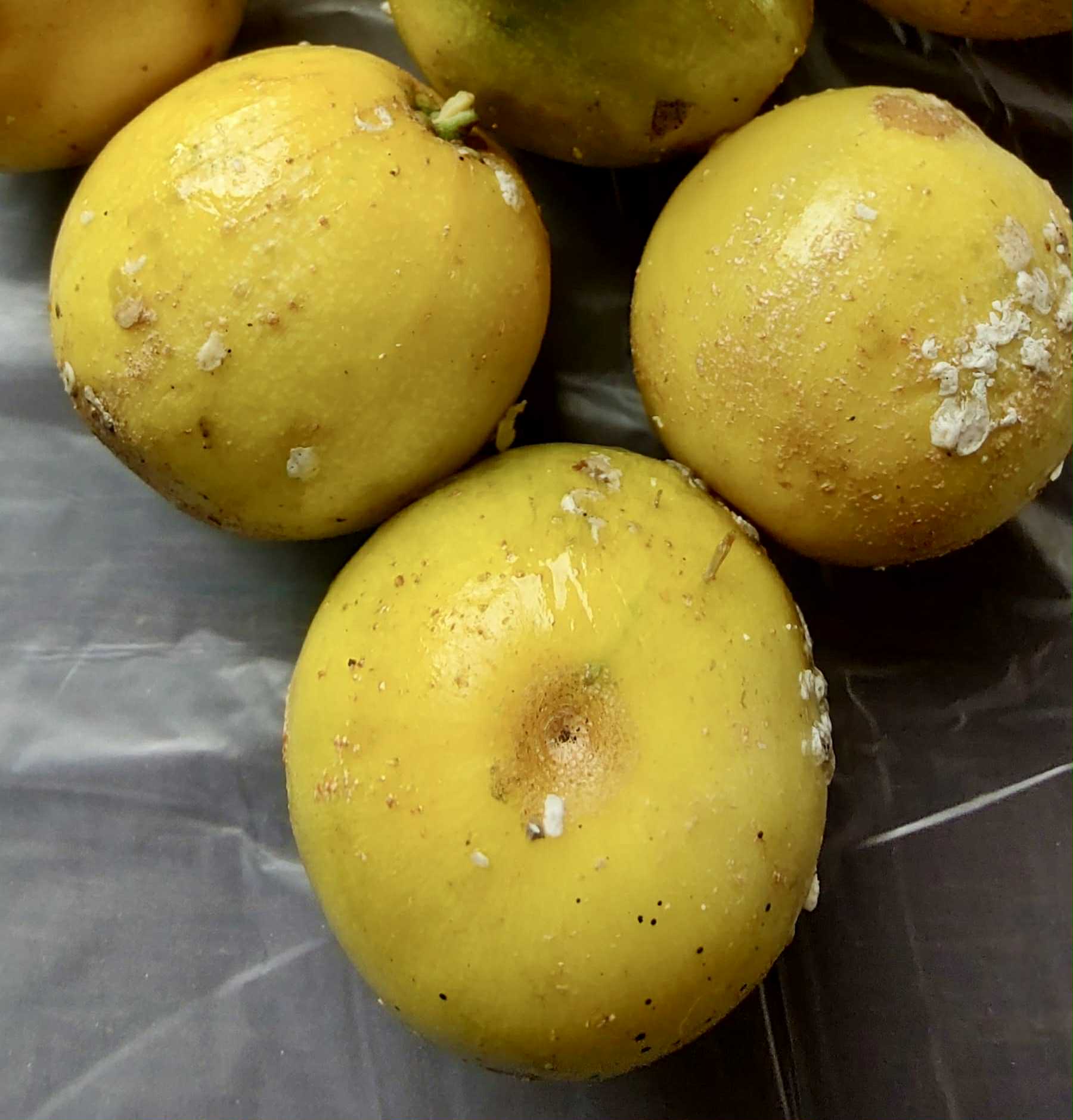
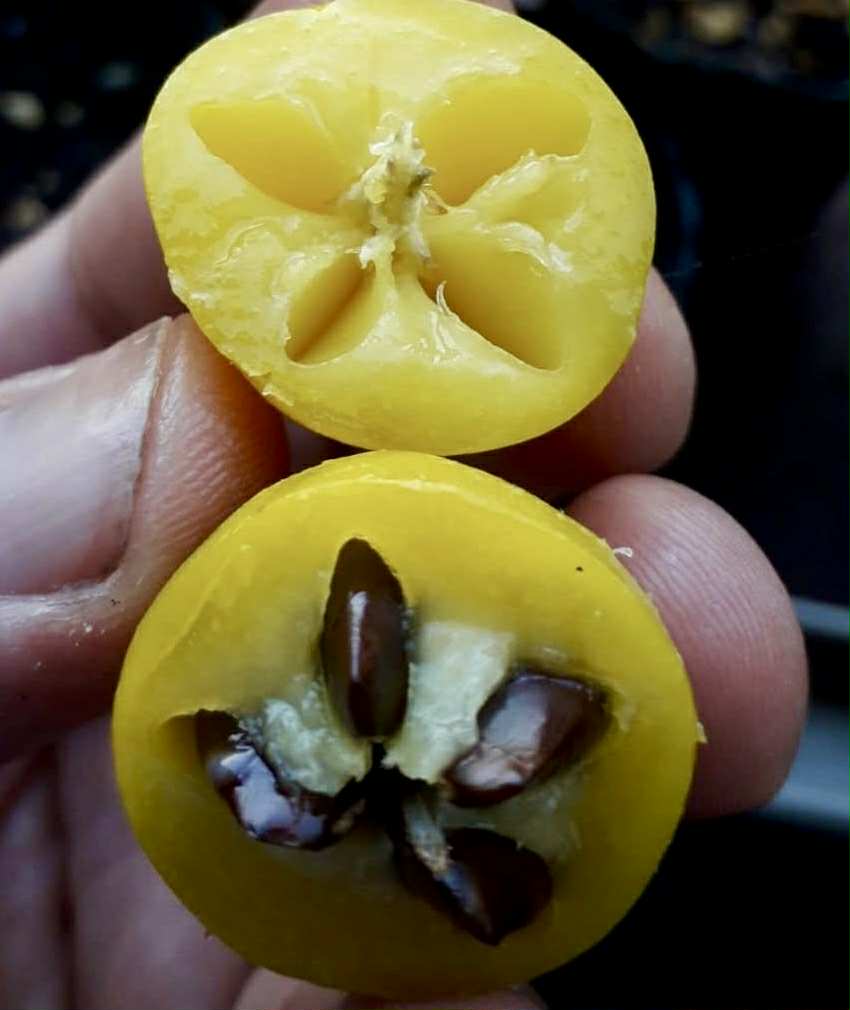
Pouteria bangii is a very rare fruit tree from the Sapotaceae family and comes from Bahia in Brazil.The tree has beautiful, typical Pouteria leaves.The small fruits are yellow and contain very sweet, juicy pulp.Please overwinter this Pouteria at a minimum of 10 degrees.Pouteria bangii ist ein sehr seltener Fruchtbaum aus der Familie der Sapotaceae und stammt aus Bahia in Brasilien.Der Baum bekommt wunderschöne, typische Pouteria Blätter.Die kleinen Früchte sind gelb und enthalten ein sehr süßes, saftiges Fruchtfleisch.Bitte diese Pouteria bei mindestens 10 Grad überwintern.
Pouteria sp Ajara Family / Familie: Sapotaceae origin from / Herkunft: Brasil / Brasilien Climate / Klima: temperate to warm (15-25C / 60-77F) / gemäßigt bis warm (15-25C / 60-77F) Taste / Geschmack: good taste / guter Geschmack you buy / sie kaufen: 1 potted plant / 1 getopfte PflanzeDelivery EU onlyHere we have a small seedling from a completely unknown and interesting Pouteria for you. Pouteria sp. Ajara comes from the Solimões River floodplain of Manaus, the capital of the Amazon in Brazil. This means that this Pouteria survives floods without any problems. The fruit of Pouteria Ajara is known for its strong taste and smell. The taste has a pleasant acidity with a slight note of pomelo. The tree only grows to a height of 4 to a maximum of 8 meters and is therefore suitable for pot cultivation. Overwinter at at least 10 degrees (better 15).Hier haben wir einen kleinen Sämling einer völlig unbekannten und interessanten Pouteria für euch. Pouteria sp. Ajara stammt aus dem Überschwemmungsgebiet des Solimões-Flusses von Manaus, der Hauptstadt des Amazonas in Brasilien. Das bedeutet, dass diese Pouteria Überschwemmungen ohne Probleme überlebt. Die Frucht der Pouteria Ajara ist für ihren starken Geschmack und Geruch bekannt. Der Geschmack hat eine angenehme Säure mit einer leichten Note von Pomelo. Der Baum wird nur 4 bis max. 8 Meter und ist deshalb für eine Topfkultur geeignet. Überwintern bei mindestens 10 Grad (besser 15).
Abiu (Pouteria caimito)Family / Familie: Sapotaceae origin from / Herkunft: South America / Südamerika Climate / Klima: warm (15-30C / 60-77F) / warm (15-30C / 60-77F) Use / Verwendung: edible fruits, juice, jam, ice cream, etc. / essbare Früchte, Säfte, Marmelade, Eis usw.you buy / sie kaufen: 1 potted plant / 1 getopfte Pflanze Delivery EU onlyAbiu is a tropical fruit from the sapote family.The pulp is jelly-like, sweet and reminiscent of the taste of Caimito with a little caramel.The fruit is very good to eat fresh or to make into ice cream.Abiu fruits have a lot of calcium, phosphorus, vitamin A and vitamin C.The plant is grown in a similar way to cocoa.It loves it warm and humid.In the Amazon, they bloom for the first time after three years and several times a year.You can find flowers and ripe fruit on one tree at the same time.The trees will later have between 100 and 1000 fruits hanging on them.Please overwinter at a temperature of at least 15 degrees.Abiu ist eine tropische Frucht aus der Familie der Sapoten. Das Fruchtfleisch ist geleeartig, süß und erinnert an den Geschmack von Caimito mit etwas Karamell. Die Frucht lässt sich sehr gut frisch essen oder zu Eis zu verarbeiten. Abiu-Früchte haben viel Kalzium, Phosphor, Vitamin A und Vitamin C. Die Haltung der Pflanze ist ähnlich dem Kakao. Sie liebt es warm und feucht. Im Amazonas blühen sie nach drei Jahren das erste mal und mehrfach im Jahr. An einem Baum kann man Blüten und gleichzeitig reife Früchte finden. An diesen Bäumen hängen später zwischen 100 und 1000 Früchten. Bitte bei mindestens 15 Grad überwintern.
Pouteria glomerata
Family / Familie: Sapotaceaeorigin from / Herkunft: Mexico / MexikoClimate / Klima: temperate to warm (10-30C / 50-86F) / gemäßigt bis warm (10-30C / 50-86F)Use / Verwendung: edible fruits, juice, jam, ice cream, etc. / essbare Früchte, Säfte, Marmelade, Eis usw.you buy / sie kaufen: 1 germinated seed / 1 gekeimter Samen
Delivery worldwideThe taste of this pouteria is fantastic with a hint of cinnamon..It grows relatively quickly and can be overwintered at at least 10 degrees.Huge beautiful leaves and great fruits.The name "Pouteria hypoglauca" is a synonym and is also sometimes used for this Pouteria.Der Geschmack dieser Pouteria ist fantastisch mit einem Hauch von Zimt.Sie wächst relativ schnell und kann bei mindestens 10 Grad überwintert werden.Riesige wunderschöne Blätter und tolle Früchte.Der Name "Pouteria hypoglauca" ist ein Synonym und wird auch manchmal für diese Pouteria verwendet.
Pouteria aff. macrocarpa Family / Familie: Sapotaceae origin from / Herkunft: Brasil / Brasilien Climate / Klima: temperate to warm (10-25C / 50-77F) / gemäßigt bis warm (10-25C / 50-77F) Use / Verwendung: edible fruits, juice, jam, ice cream, etc. / essbare Früchte, Säfte, Marmelade, Eis usw.you buy / sie kaufen: 1 potted seedling / 1 getopfter Sämling Delivery EU onlyThis rare Pouteria looks very similar to the Pouteria macrocarpa.This Pouteria was discovered in the Mata Atlantica in the Brazilian state of Bahia.The seeds are not grooved like the macrocarpa, but smooth.The pattern of the seeds is also impressive.The areas that are smooth on a Pouteria seed are rough here and the areas that are rough are smooth here.This Pouteria becomes a beautiful tree with large leaves.The flesh of this Pouteria is very sweet, moister than Lucuma and very tasty.You can also make juices, ice cream and jams from it.Please overwinter at a temperature of at least 10 degrees.Diese seltene Pouteria sieht der Pouteria macrocarpa sehr ähnlich.Entdeckt wurde diese Pouteria im Mata Atlantica im brasilianischen Bundesstaat Bahia.Die Samen sind nicht wie bei der macrocarpa gefurcht, sondern glatt.Auch die Musterung des Samens ist beeindruckend.Die Stellen, die bei einem Pouteria Samen glatt sind, sind hier rauh und die Stellen die rauh sind, sind hier glatt.Diese Pouteria wird ein wunderschöner Baum mit großen Blättern.Das Fruchtfleisch dieser Pouteria ist sehr süß, feuchter als Lucuma und sehr schmackhaft. Man kann daraus auch Säfte, Eis und Marmeladen herstellen. Bitte bei mindestens 10 Grad überwintern.
Pouteria aff egregia
Family / Familie: Sapotaceaeorigin from / Herkunft: Brasil / Brasilien Climate / Klima: temperate to warm (15-30C / 59-86F) / gemäßigt bis warm (15-30C / 59-86F)Use / Verwendung: edible fruits, juice, jam, ice cream, etc. / essbare Früchte, Säfte, Marmelade, Eis usw.you buy / sie kaufen: 1 potted seedling / 1 getopfter Sämling
Delivery EU onlyPouteria aff. egregia – Ultra-Rare Fruit from the UNA National Park in Bahia
Description:Pouteria aff. egregia is a true rarity among tropical fruit plants, discovered in the lush UNA National Park in Bahia, Brazil. This extraordinary Pouteria catches the eye with its beautiful, vibrant yellow fruits, making it a must-have for exotic plant enthusiasts.
Special Features:
Fruits: The fruits of this Pouteria are not only visually stunning but also a real treat for the taste buds. The flesh is incredibly sweet, juicy, and contains very little latex, making it perfect for eating fresh or processing into various delicious treats.
Uses: The fruits can be enjoyed fresh, but they are also excellent for making refreshing juices, creamy ice creams, and other delightful recipes.
Seeds: The seeds are freshly harvested and viable, allowing you the opportunity to grow this rare plant yourself, either in your garden or in a pot.
Rarity: This plant is a true botanical gem and a must-have for collectors of rare and exotic fruit plants.
Care Instructions:
For winter, keep this Pouteria at a minimum temperature of 15°C (59°F).
It prefers a warm, sunny location and is well-suited for both garden planting and container cultivation.
Pouteria aff. egregia – Ultra seltene Frucht aus dem UNA Nationalpark in Bahia
Beschreibung:Die Pouteria aff. egregia ist eine wahre Rarität unter den tropischen Fruchtpflanzen und wurde im üppigen UNA Nationalpark in Bahia, Brasilien, entdeckt. Diese außergewöhnliche Pouteria zieht mit ihren wunderschönen, leuchtend gelben Früchten die Aufmerksamkeit aller Liebhaber exotischer Pflanzen auf sich.
Besonderheiten:
Früchte: Die Früchte dieser Pouteria sind nicht nur optisch ein Genuss, sondern auch geschmacklich ein absolutes Highlight. Das Fruchtfleisch ist unglaublich süß, saftig und enthält nur wenig Latex – ideal für den direkten Verzehr oder die Weiterverarbeitung.
Verwendung: Die Früchte können frisch verzehrt werden, eignen sich aber auch hervorragend zur Herstellung von erfrischendem Saft, cremigem Eis und anderen köstlichen Leckereien.
Samen: Die Samen sind ganz frisch und keimfähig, sodass du die Möglichkeit hast, diese seltene Pflanze selbst zu kultivieren und in deinem Garten oder Topf zu züchten.
Seltenheit: Diese Pflanze ist eine wahre botanische Entdeckung und ein absolutes Muss für Sammler seltener und exotischer Fruchtpflanzen.
Pflegehinweis:
Diese Pouteria benötigt für den Winter eine Temperatur von mindestens 15°C.
Sie bevorzugt einen warmen, sonnigen Standort und eignet sich sowohl für den Garten als auch für die Topfkultur.
Pouteria macahensis
Family / Familie: Sapotaceaeorigin from / Herkunft: Brasil / BrasilienClimate / Klima: temperate to warm (15-30C / 59-86F) / gemäßigt bis warm (15-30C / 59-86F)Use / Verwendung: edible fruits, juice, jam, ice cream, etc. / essbare Früchte, Säfte, Marmelade, Eis usw.you buy / sie kaufen: 1 potted seedling / 1 getopfter SämlingDelivery EU onlyThis is one of the very rare sapotes from Brazil.The last two observations come from the Brazilian state of Espirito Santo.There the Mata Atlantica stretches to the Reserva Biologica de Sooretama.This species is on the IUCN list and is considered to be threatened with extinction.The tree is medium-sized with leaves typical of Pouteria.It grows near rivers and is fast-growing.The fruits have a velvety skin and edible flesh.Nothing is known about the taste of the fruits because it is too rare.Please overwinter this plant at a temperature of at least 15 degrees.Das ist eine der sehr seltenen Sapoten aus Brasilien.Die letzten beiden Beobachtungen stammen aus dem brasilianischen Bundesstaat Espirito Santo.Dort zieht sich der Mata Atlantica bis zum Reserva Biologica de Sooretama.Diese Art steht in der IUCN Liste und gilt als vom Aussterben bedroht.Der Baum ist mittelgroß mit Pouteria-typischen Blättern.Er wächst in Flußnähe und ist schnellwachsend.Die Früchte haben eine samtige Schale und essbares Fruchtfleisch.Über den Geschmack der Früchte ist nichts bekannt da er zu selten ist.Bitte diese Pflanze bei mindestens 15 Grad überwintern.
Pouteria bangii Family / Familie: Sapotaceae origin from / Herkunft: Brasil / Brasilien Climate / Klima: temperate to warm (15-30C / 59-86F) / gemäßigt bis warm (15-30C / 59-86F)Use / Verwendung: edible fruits, juice, jam, ice cream, etc. / essbare Früchte, Säfte, Marmelade, Eis usw.you buy / sie kaufen: 1 potted plant / 1 getopfte PflanzeDelivery EU only
Pouteria bangii is a very rare fruit tree from the Sapotaceae family and comes from Bahia in Brazil.The tree has beautiful, typical Pouteria leaves.The small fruits are yellow and contain very sweet, juicy pulp.Please overwinter this Pouteria at a minimum of 10 degrees.Pouteria bangii ist ein sehr seltener Fruchtbaum aus der Familie der Sapotaceae und stammt aus Bahia in Brasilien.Der Baum bekommt wunderschöne, typische Pouteria Blätter.Die kleinen Früchte sind gelb und enthalten ein sehr süßes, saftiges Fruchtfleisch.Bitte diese Pouteria bei mindestens 10 Grad überwintern.
Chrysophyllum januariense
Family / Familie: Sapotaceaeorigin from / Herkunft: Brasil / Brasilien Climate / Klima: temperate to warm (15-30C / 59-86F) / gemäßigt bis warm (15-30C / 59-86F)Use / Verwendung: edible fruits, juice, jam, ice cream, etc. / essbare Früchte, Säfte, Marmelade, Eis usw.you buy / sie kaufen: 1 potted seedling / 1 getopfter Sämling
Delivery EU onlyHoly moly, this fruit, which is known to be almost extinct, was recently rediscovered.It was considered extinct for almost 100 years!But wait. Let's start from the beginning:In 1869, the German botanist August Wilhelm Eichler (who died of leukemia at the age of 47) first described this fruit in his work Flora Brasiliensis.Then came the time of emptiness.The tree was not found for over 100 years and was considered extinct or "almost extinct".But in 1987 the tree was rediscovered in the municipality of Saquarema and in 1995 in the municipality of Cabo Frio.In each case in the Restingas of the state of Rio de Janeiro.The tree is still on the IUCN (International Union for Conservation of Nature) list as almost extinct.Are the fruits actually tasty?Yes, they are! Many fruits from the sapote family (especially Pouteria) have a rather dry pulp and are suitable for juices, ice cream, etc.Fruits of the Chrysophyllum species are rather juicy. This is known from Abiu and Star-Apple (Caimito).This fruit is as sweet as sugar and has a juicy pulp with the consistency of a white sapote.The tree does not grow very large and has typical Chrysophyllum leaves.What is typical about it?Very simple. The underside of these leaves is very different from the top of the leaves. Sometimes they shimmer gold and sometimes silver.Once again, an almost extinct species has been found and shows us that nature is beautiful.Please mix some sand into the soil, as this plant comes from the Restinga.Please overwinter at a temperature of at least 15 degrees.Holy Moly, vor kurzer Zeit wurde diese Frucht wieder gefunden, von der man weiß, dass sie fast ausgestorben ist.Sie galt für fast 100 Jahre als ausgestorben!Doch halt. Beginnen wir von vorn:1869 hat der deutsche Botaniker August Wilhelm Eichler (gestorben mit 47 Jahren an Leukämie) diese Frucht erstmals in seinem Werk Flora Brasiliensis beschrieben.Dann kam die Zeit der Leere.Über 100 Jahre wurde der Baum nicht mehr gefunden und galt als ausgestorben oder „fast ausgestorben“.Doch 1987 wurde der Baum in der Gemeinde Saquarema und 1995 in der Gemeinde Cabo Frio wieder entdeckt.Jeweils in den Restingas des Bundesstaates Rio de Janeiro.Der Baum steht noch immer in der IUCN Liste (International Union for Conservation of Nature) als fast ausgestorben.Sind die Früchte eigentlich lecker?Ja sind sie!Viele Früchte aus der Sapotenfamilie (vor allem Pouteria) haben ein eher trockenes Fruchtfleisch und eignen sich für Säfte, Eis usw.Früchte der Chrysophyllum Arten sind eher saftig. Man kennt das von Abiu und Star-Apple (Caimito).Diese Frucht hier ist zuckersüß und hat ein saftiges Fruchtfleisch von der Konsistenz einer Weißen Sapote.Der Baum wird nicht sehr groß und hat typische Chrysophyllum Blätter.Was ist denn da typisch?Ganz einfach. Die Unterseite dieser Blätter unterscheidet sich wesentlich von der Oberseite der Blätter. Manchmal schimmern sie gold und manchmal silbern.Wieder einmal ist eine fast ausgestorbene Art gefunden worden und zeigt uns, dass die Natur wunderschön ist.Bitte der Erde etwas Sand zumischen, da diese Pflanze aus der Restinga kommt.Überwintern bitte bei mindestens 15 Grad.
Pouteria glomerata
Family / Familie: Sapotaceaeorigin from / Herkunft: Mexico / MexikoClimate / Klima: temperate to warm (10-30C / 50-86F) / gemäßigt bis warm (10-30C / 50-86F)Use / Verwendung: edible fruits, juice, jam, ice cream, etc. / essbare Früchte, Säfte, Marmelade, Eis usw.you buy / sie kaufen: 1 fresh seed / 1 frischer Samen
Delivery worldwideThe taste of this pouteria is fantastic with a hint of cinnamon..It grows relatively quickly and can be overwintered at at least 10 degrees.Huge beautiful leaves and great fruits.The name "Pouteria hypoglauca" is a synonym and is also sometimes used for this Pouteria.Der Geschmack dieser Pouteria ist fantastisch mit einem Hauch von Zimt.Sie wächst relativ schnell und kann bei mindestens 10 Grad überwintert werden.Riesige wunderschöne Blätter und tolle Früchte.Der Name "Pouteria hypoglauca" ist ein Synonym und wird auch manchmal für diese Pouteria verwendet.