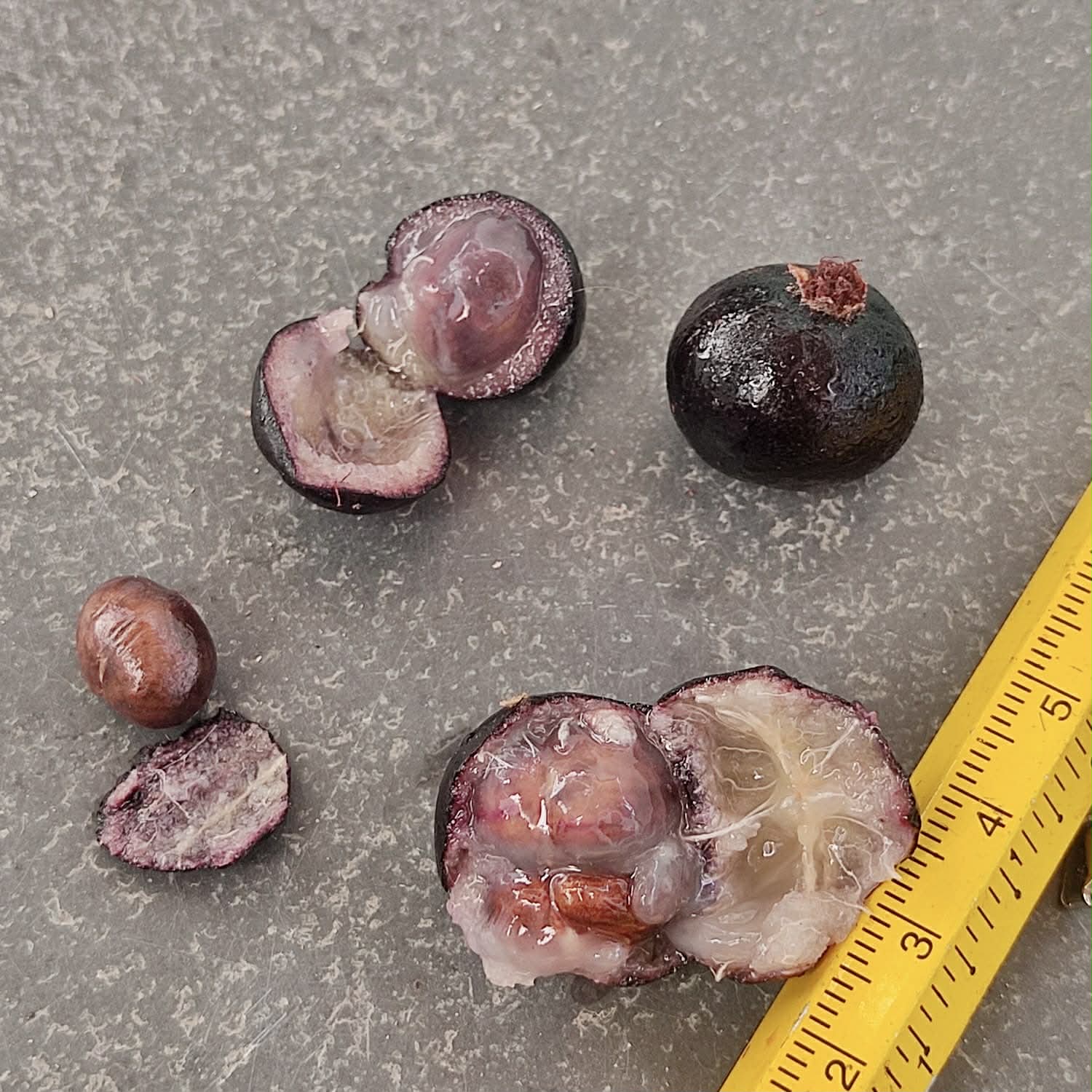
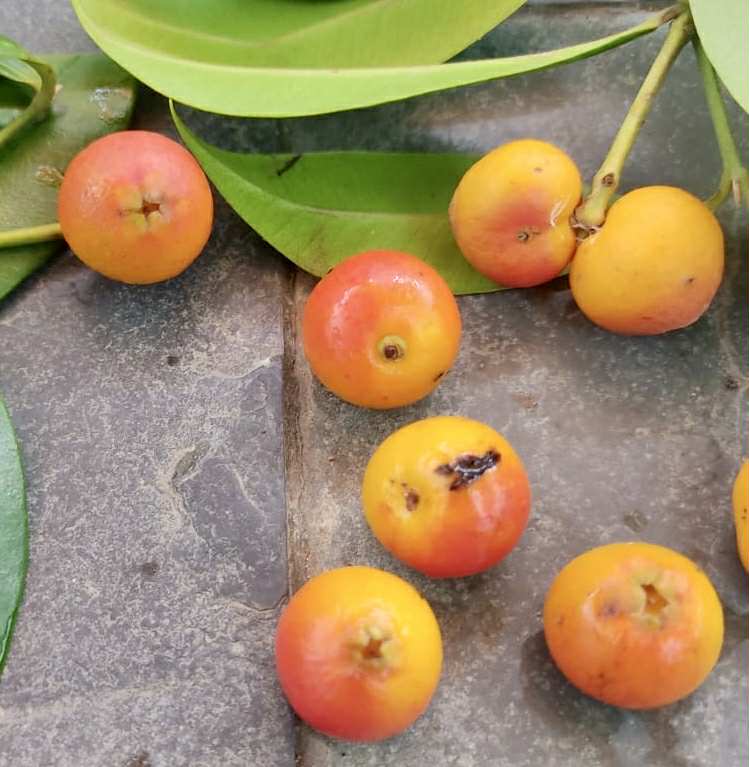
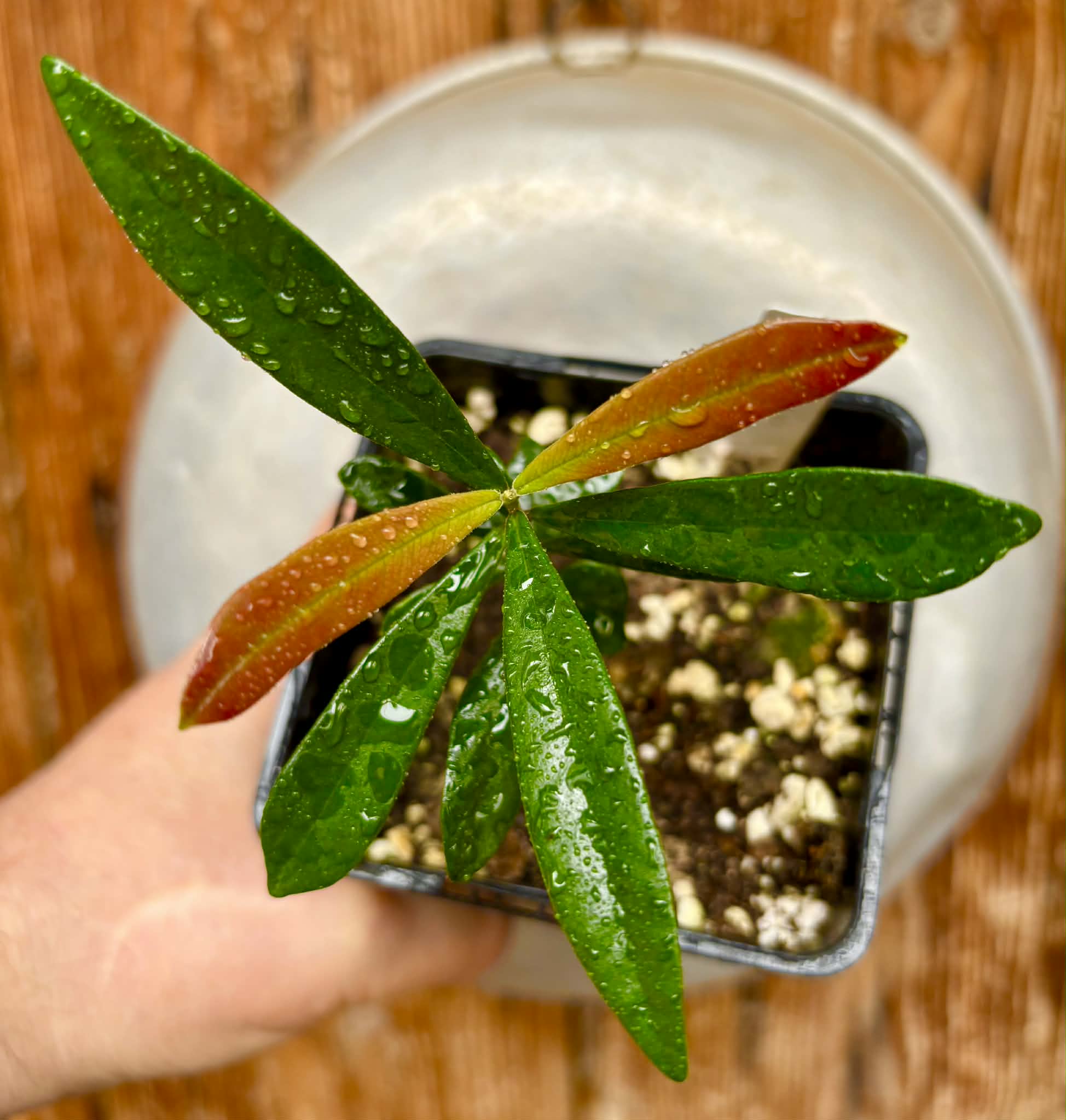
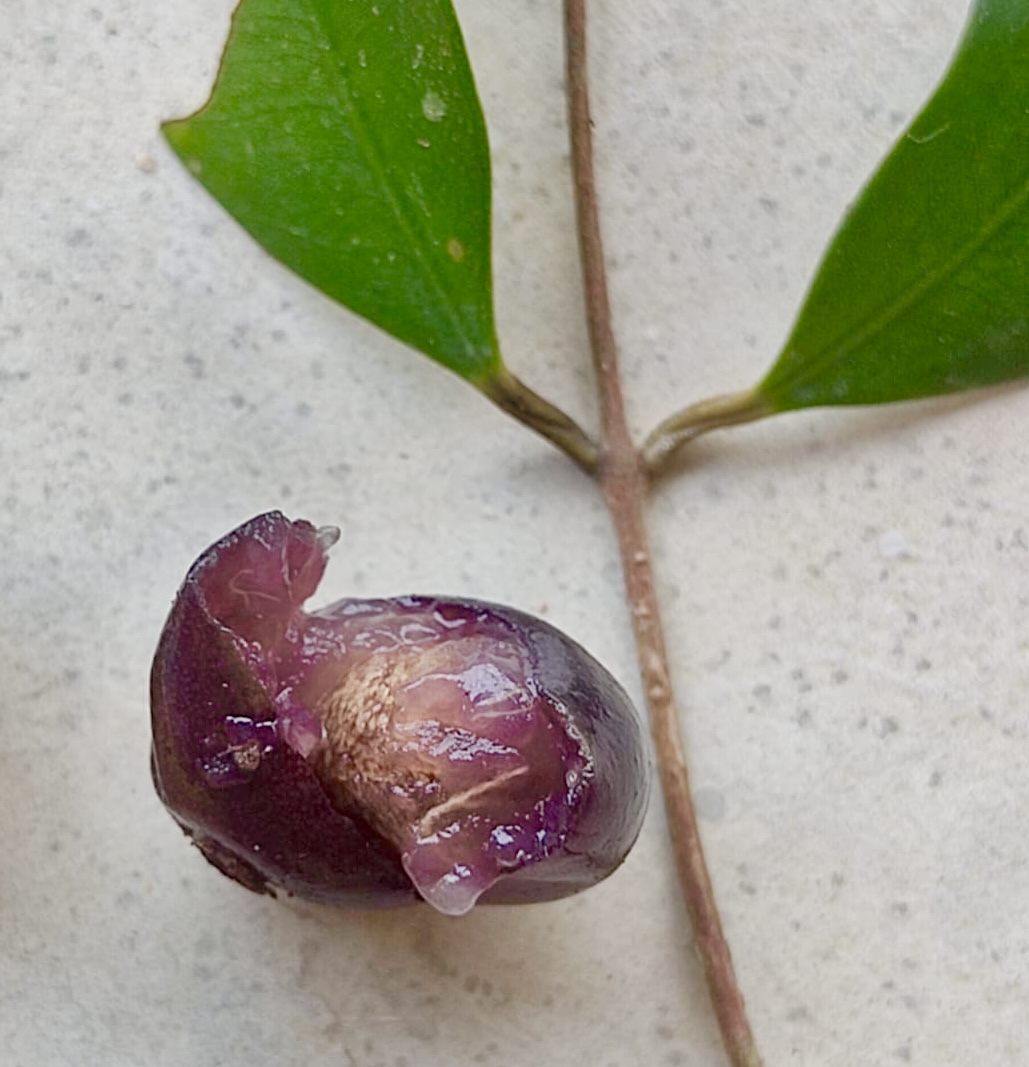
Myrcia sp Jaboticaba de PencaFamily / Familie: Myrtaceae origin from / Herkunft: Brasil / BrasilienClimate / Klima: temperate to warm (10-30C / 50-86F) / gemäßigt bis warm (10-30C / 50-86F)Use / Verwendung: edible fruits, juice, jam, ice cream, etc. / essbare Früchte, Säfte, Marmelade, Eis usw.you buy / sie kaufen: 1 fresh seed / 1 frischer SamenDelivery worldwidePre-order – these fresh seeds will be delivered in mid-April.
Exclusive Rarity from Bahia: Myrcia sp. "Jaboticaba de Penca"With Myrcia sp. "Jaboticaba de Penca," we are proud to present an absolute highlight for lovers of Brazilian Myrtaceae, sourced directly from the Mata Atlântica in Bahia. This extraordinary discovery is a true gem for any collection, seamlessly blending botanical elegance with an outstanding fruiting experience.
The name of this species says it all: the flavor of the remarkably large fruits intensely resembles the beloved Jaboticaba. Its crystal-clear, jelly-like pulp is exceptionally succulent, delicious, and characterized by a profound sweetness that will delight collectors and gourmets alike.
Visually, this medium-sized tree is a stunning addition to any conservatory or container garden.It develops a characteristic smooth white trunk that creates a striking contrast against its deep green, glossy foliage. To ensure the plant thrives, it should be kept in a bright location and overwintered at a minimum temperature of 10°C (50°F).
This is a pre-order, as the fresh seeds will not be delivered until mid-April. Since the seeds are reserved specifically for you, the "Additional Order" option is not available for this item. Please select the standard shipping costs of €4 within Germany or €8 for international shipping during checkout.Vorbestellung - die Lieferung dieser frischen Samen erfolgt Mitte April.Exklusive Rarität aus Bahia: Myrcia sp. „Jaboticaba de Penca“Mit der Myrcia sp. Jaboticaba de Penca präsentieren wir euch ein absolutes Highlight für Liebhaber brasilianischer Myrtengewächse direkt aus dem Mata Atlântica in Bahia. Diese außergewöhnliche Neuentdeckung ist ein wahres Juwel für jede Sammlung, da sie botanische Eleganz mit einem herausragenden Fruchterlebnis verbindet.
Der Name dieser Art ist Programm, denn der Geschmack der außerordentlich großen Früchte erinnert intensiv an die beliebte Jaboticaba. Das glasklar-gallertartige Fruchtfleisch ist überaus saftig, wohlschmeckend und besticht durch eine ausgeprägte Süße, die Sammler und Genießer gleichermaßen begeistert.
Auch optisch ist dieser mittelgroße Baum eine Bereicherung für jeden Wintergarten oder die Kübelhaltung. Er bildet einen charakteristischen, glatten weißen Stamm aus, der in einem reizvollen Kontrast zu den tiefgrünen, glänzenden Blättern steht. Damit die Pflanze optimal gedeiht, sollte sie hell stehen und bei mindestens 10 Grad Celsius überwintert werden.
Es handelt sich hierbei um eine Vorbestellung, da die Auslieferung der frischen Samen erst Mitte April erfolgt. Da die Samen frisch für dich reserviert werden, ist die Option "Zusatzbestellung" für diesen Artikel nicht verfügbar. Bitte wähle im Bestellvorgang die regulären Versandkosten von 4 EUR innerhalb Deutschlands bzw. 8 EUR für den internationalen Versand aus.
Myrcia sp linda
Family / Familie: Myrtaceaeorigin from / Herkunft: Brasil / BrasilienClimate / Klima: temperate to warm (15-30C / 59-86F) / gemäßigt bis warm (15-30C / 59-86F)Use / Verwendung: edible fruits, juice, jam, ice cream, etc. / essbare Früchte, Säfte, Marmelade, Eis usw.you buy / sie kaufen: 1 potted seedling / 1 getopfter Sämling
Delivery EU onlyThe genus Myrcia has many different species and a few, as yet unidentified, species.Like this Myrcia sp. Linda.Linda means "beautiful," and this Myrcia is just that.Beautiful and extraordinarily large fruits.These fruits taste very good and are delicious.The Brazilian collector Helton Muniz says that some Myrcia fruits taste even better than Jaboticaba.This Myrcia was found in Bahia, Brazil.This Myrcia can be grown well in pots and will also flower and fruit in tubs.In the first year, place in partial shade and avoid waterlogging.Please overwinter at a minimum temperature of 15 degrees Celsius.Die Gattung Myrcia shat viele verschiedene Arten und einige wenige, bisher noch nicht identifizierte Arten.Wie diese Myrcia sp Linda.Linda bedeudet "schön" und das ist diese Myrcia auch.Wunderschöne und außerordentlich große Früchte.Diese Früchte schmecken sehr gut und sind lecker.Der brasilianische Sammler Helton Muniz sagt, dass einige Myrcia Früchte noch besser schmecken sollen als Jaboticaba.Gefunden wurde diese Myrcia in Bahia, Brasilien.Diese Myrcia kann gut im Topf angebaut werden und blüht bzw. fruchtet auch im Kübel.Im ersten Jahr halbschattig stellen und Staunässe vermeiden.Bitte bei mindestens 15 Grad überwintern.
Myrcia luschnathianaFamily / Familie: Myrtaceae origin from / Herkunft: Brasil / Brasilien Climate / Klima: temperate to warm (10-25C / 50-77F) / gemäßigt bis warm (10-25C / 50-77F) Use / Verwendung: edible fruits, juice, jam, ice cream, etc. / essbare Früchte, Säfte, Marmelade, Eis usw.you buy / sie kaufen: 1 potted seedling / 1 getopfter SämlingDelivery EU onlyMyrcia luschnathiana – rare myrcia for exotic plant collectors
Product descriptionMyrcia luschnathiana, not to be confused with Eugenia luschnathiana, is a compact evergreen shrub native to the coastal forests of southeastern Brazil. In container culture it typically reaches 1.5 to 2 metres in height. The lanceolate, glossy dark green leaves and the numerous small white flowers create an attractive contrast and attract pollinators.
Taste and useWhen fully ripe, the berries develop a deep black colour and offer a delicate sweetness with floral and ripe‑berry notes reminiscent of apricot. The fruits are rich in vitamins and can be eaten fresh or used in preserves, sorbets and fruit juices.
Origin, leaves and fruitThis species originates from the Atlantic rainforest in the state of Rio de Janeiro, where it grows along sunny forest edges and in clearings. The evergreen leaves emit a subtle spicy aroma when gently crushed. The inconspicuous flowers give way to thin‑skinned black berries that split open at full maturity.
Care
Location: bright to fully sunlit position protected from strong winds; ideal for a south‑facing balcony, conservatory or greenhouse
Substrate: well‑draining, humus‑rich and slightly acidic (pH 5.5–6.5)
Watering: keep the substrate evenly moist, avoid waterlogging; use low‑mineral (soft) water
OverwinteringMyrcia luschnathiana does not tolerate temperatures below 10 °C. In winter, move the plant to a bright, frost‑free location and reduce watering intervals so that the soil remains just slightly moist. Maintaining a relative humidity of around 60 % helps preserve healthy foliage.
SummaryThis Myrcia species demands attentive cultivation but rewards with unusual black fruits and a refined flavour. It represents a valuable addition to any collection of exotic fruit plants.
Myrcia luschnathiana – seltene Pflanze für Exoten-Sammler
ProduktbeschreibungMyrcia luschnathiana, nicht zu verwechseln mit Eugenia luschnathiana, ist ein kompakter immergrüner Strauch aus den Küstenwäldern Südostbrasiliens. Er erreicht im Kübel eine Höhe von 1,5 bis 2 Metern. Die lanzettlichen Blätter sind glänzend dunkelgrün, die zahlreich erscheinenden weißen Blüten duften dezent und ziehen Bestäuber an.
Geschmack und NutzenDie Beeren reifen zu einer tiefschwarzen Farbe heran. Ihr feines, süßes Aroma trägt florale und fruchtige Nuancen, die an Aprikose und reife Beeren erinnern. Die Früchte sind roh genießbar und besonders vitaminreich; sie eignen sich für den Frischverzehr ebenso wie zur Verarbeitung in Marmeladen, Sorbets und Fruchtsäften.
Herkunft, Blätter und FrüchteMyrcia luschnathiana stammt aus dem Atlantischen Regenwald im Bundesstaat Rio de Janeiro. Im natürlichen Habitat besiedelt sie sonnige Waldränder und Lichtungen. Die immergrünen Blätter verströmen bei leichter Reibung ein dezentes, würziges Aroma. Aus den unscheinbaren Blüten entwickeln sich die schwarzen Beeren, deren zarte Schale bei voller Reife aufbricht.
Pflege
Standort: hell bis vollsonnig, geschützt vor starkem Wind; ideal sind Südbalkon, Wintergarten oder Gewächshaus
Substrat: durchlässig, humusreich und leicht sauer (pH 5,5–6,5)
Gießen: gleichmäßig feucht halten, Staunässe vermeiden; kalkarmes Wasser verwenden
ÜberwinterungMyrcia luschnathiana mag keine Temperaturen unter 10 °C. Im Winter an einen hellen, frostfreien Platz stellen und das Gießintervall reduzieren, ohne die Erde vollständig austrocknen zu lassen. Eine relativ hohe Luftfeuchtigkeit (ca. 60 %) unterstützt den gesunden Erhalt des Blattwerks.
ZusammenfassungDiese Myrcia-Art erfordert erfahrene Pflege, belohnt jedoch mit ungewöhnlichen schwarzen Beeren und einem feinen Fruchtaroma. Sie ist eine wertvolle Ergänzung für jede Sammlung exotischer Fruchtpflanzen.
Myrcia multifloraFamily / Familie: Myrtaceaeorigin from / Herkunft: Santa Catarina (Brasil) / Santa Catarina (Brasilien)Climate / Klima: temperate to warm (10-30C / 50-86F) / gemäßigt bis warm (10-30C / 50-86F)Use / Verwendung: edible fruits, juice, jam, ice cream, etc. / essbare Früchte, Säfte, Marmelade, Eis usw.you buy / sie kaufen: 1 potted seedling / 1 getopfter SämlingDelivery EU only
Myrcia multiflora, often known in Brazil as Pedra-Ume-Caá or the "insulin plant," is an evergreen shrub belonging to the myrtle family (Myraceae).Taste of the FruitThe fruits are small, spherical berries that turn dark purple to black when ripe.They are considered very sweet and delicious.Besides being eaten fresh, they are also used in South America to make drinks.The plant's leaves also have a long tradition in folk medicine (including for regulating blood sugar levels).Care and LocationPrefers a bright to full-sun location but should be protected from extremely strong winds.An ideal spot is on a south-facing balcony or in a conservatory.Since it originates from tropical regions of Brazil, it is not frost-hardy.It requires warmth year-round and should be overwintered at a minimum temperature of 10°C (50°F).The plant requires well-draining, humus-rich, and slightly acidic soil (pH approx. 5.5–6.5).The substrate should be kept consistently moist, but waterlogging must be strictly avoided.It grows relatively quickly and usually reaches a height of 1.5 to 2 meters in a container; it can be pruned to shape as needed.Myrcia multiflora, in Brasilien oft als Pedra-Ume-Caá oder „Insulinpflanze“ bekannt, ist ein immergrüner Strauch aus der Familie der Myrtengewächse. Geschmack der FrüchteDie Früchte sind kleine, kugelige Beeren, die bei Reife dunkelviolett bis schwarz werden.Sie gelten als sehr süß und schmackhaft.Neben dem direkten Verzehr werden sie in Südamerika auch für Getränke verwendet.Die Blätter der Pflanze haben zudem eine lange Tradition in der Volksmedizin (u. a. zur Regulierung des Blutzuckerspiegels). Haltung und StandortBevorzugt einen hellen bis vollsonnigen Standort, sollte jedoch vor extrem starken Winden geschützt werden. Ideal ist ein Platz auf einem Südbalkon oder im Wintergarten.Da sie aus tropischen Regionen Brasiliens stammt, ist sie nicht frosthart. Sie benötigt ganzjährig Wärme und sollte bei mindestens 10 °C überwintert werden.Die Pflanze benötigt einen gut durchlässigen, humosen und leicht sauren Boden (pH-Wert ca. 5,5–6,5). Das Substrat sollte gleichmäßig feucht gehalten werden, wobei Staunässe unbedingt zu vermeiden ist.Sie wächst relativ schnell und erreicht im Kübel meist eine Höhe von 1,5 bis 2 Metern; sie kann bei Bedarf in Form geschnitten werden.
Myrcia sp Trancoso
Family / Familie: Myrtaceaeorigin from / Herkunft: Brasil / BrasilienClimate / Klima: temperate to warm (15-30C / 59-86F) / gemäßigt bis warm (15-30C / 59-86F)Use / Verwendung: edible fruits, juice, jam, ice cream, etc. / essbare Früchte, Säfte, Marmelade, Eis usw.you buy / sie kaufen: 1 potted seedling / 1 getopfter Sämling
Delivery EU onlySome specimens of the Myrcia genus are true treasures.Like this Myrcia sp. Trancoso.Leaves reminiscent of a Myrciaria—except these leaves are larger—and the fruits have an excellent flavor.These fruits taste like jaboticaba and are very delicious.The Brazilian collector Helton Muniz also says that some Myrcia fruits taste even better than jaboticaba.This Myrcia was discovered in the UNA National Park in Bahia, Brazil.This Myrcia can be grown well in pots and will also flower and fruit in tubs.Place in partial shade during the first year and avoid waterlogging.Please overwinter at a temperature of at least 15 degrees Celsius.Manche Exemplare der Gattung Myrcia sind wahre Schätze.Wie diese Myrcia sp Trancoso.Blätter die an eine Myrciaria erinnern - nur das diese Blätter größer sind und Früchte mit einem hervorragenden Geschmack.Diese Früchte schmecken wie Jaboticaba und sind sehr lecker.Auch der brasilianische Sammler Helton Muniz sagt, dass einige Myrcia Früchte noch besser schmecken sollen als Jaboticaba.Entdeckt wurde diese Myrcia im UNA Nationalpark in Bahia, Brasilien.Diese Myrcia kann gut im Topf angebaut werden und blüht bzw. fruchtet auch im Kübel.Im ersten Jahr halbschattig stellen und Staunässe vermeiden.Bitte bei mindestens 15 Grad überwintern.
Myrcia sp Jaboticaba Bahia
Family / Familie: Myrtaceaeorigin from / Herkunft: Brasil / BrasilienClimate / Klima: temperate to warm (15-30C / 59-86F) / gemäßigt bis warm (15-30C / 59-86F)Use / Verwendung: edible fruits, juice, jam, ice cream, etc. / essbare Früchte, Säfte, Marmelade, Eis usw.you buy / sie kaufen: 1 small potted seedling / 1 kleiner, getopfter Sämling
Delivery EU onlyThis Myrcia is our biggest surprise this year!It's starting out with a red stem like the Mao de Tigre (Duguetia stenantha)—that's going to be interesting.Myrcia sp. Jaboticaba Bahia – Exotic Myrcia from the Mata Atlantica
Description:Myrcia sp. Jaboticaba Bahia is an extraordinary and rare plant from the Mata Atlantica in Bahia, Brazil. This Myrcia is one of two varieties known as “Jaboticaba,” the other being from the Cerrado region. Both taste fantastic and have a flavor reminiscent of the well-known Jaboticaba fruits.
Special Features:
Fruits: The fruits of this Myrcia taste incredible and remind one of the famous Jaboticaba fruits, which are cherished for their unique sweet flavor.
Growth: This Myrcia sp. Jaboticaba Bahia grows faster than its Cerrado counterpart and has distinctly different leaves. Despite its rapid growth, the tree remains relatively small, making it ideal for container cultivation.
Leaves: The leaves of this variety are noticeably different from those of the Cerrado variety, giving it a unique appearance among other Myrcia species.
Rarity: This species is a rarity and an exciting find for collectors of exotic, tropical plants.
Care Instructions:
Overwinter at a minimum of 15°C (59°F).
Prefers a sunny location and is well-suited for container cultivation, making it perfect for growing in cooler climates.
Diese Myrcia ist die größte Überraschung für uns in diesem Jahr!Sie beginnt mit einem roten Stiel zu wachsen wie die Mao de Tigre (Duguetia stenantha) - das wird interessant.Myrcia sp. Jaboticaba Bahia – Exotische Myrcia aus dem Mata Atlantica
Beschreibung:Die Myrcia sp. Jaboticaba Bahia ist eine außergewöhnliche und seltene Pflanze aus dem Mata Atlantica in Bahia, Brasilien. Diese Myrcia gehört zu einer Gruppe von zwei verschiedenen Myrcia mit dem Namen „Jaboticaba“, von denen eine aus der Cerrado-Region stammt und diese hier aus dem üppigen Mata Atlantica.
Besonderheiten:
Früchte: Die Früchte dieser Myrcia schmecken fantastisch und erinnern an die bekannten Jaboticaba-Früchte, die für ihren einzigartigen, süßen Geschmack geschätzt werden.
Wachstum: Diese Myrcia sp. Jaboticaba Bahia wächst schneller als ihre Verwandte aus dem Cerrado und bildet völlig andere Blätter. Der Baum bleibt dennoch relativ klein und eignet sich daher hervorragend für die Kultivierung im Topf.
Blätter: Im Vergleich zur Cerrado-Variante hat diese Myrcia eine deutlich andere Blattstruktur, die sie von anderen Myrcia Arten unterscheidet.
Rarität: Diese Art ist eine Rarität und eine fantastische Entdeckung für Sammler exotischer, tropischer Pflanzen.
Pflegehinweis:
Überwinterung bei mindestens 15°C erforderlich.
Diese Pflanze bevorzugt einen sonnigen Standort und eignet sich gut für eine Topfkultur, sodass sie auch in kühleren Klimazonen kultiviert werden kann.
Myrcia sp Jequitinhonha
Family / Familie: Myrtaceaeorigin from / Herkunft: Minas Gerais (Brasil) / Minas Gerais (Brasilien)Climate / Klima: temperate to warm (10-25C / 50-77F) / gemäßigt bis warm (10-25C / 50-77F)Use / Verwendung: edible fruits, juice, jam, ice cream, etc. / essbare Früchte, Säfte, Marmelade, Eis usw.you buy / sie kaufen: 1 potted seedling / 1 getopfter Sämling
Delivery EU only
Within the Myrtaceae family there are notable fruit-producing genera such as:Psidium, Syzygium, Plinia, Eugenia, Myrciaria, Campomanesia and also Myrcia.This Myrcia offered here was discovered in the Mata Atlantica in the valley of Jequitinhonha.By the way, the legendary Solanum schizandrum also comes from there.
Myrcia fruits are approx. 1 to 2cm large and there are several varieties with an excellent taste.Many of them can even compete with the Jaboticaba fruits in terms of taste and taste just as good.The finder of this Myrcia described the taste of the fruit as very juicy, sweet and pleasant.The Myrcia sp Jequitinhonha remains a small tree with typically opposite leaves reminiscent of a Eugenia or Myrciaria.
The fruits ripen from green to red and then to a dark purple, almost black color.Please overwinter this plant at at least 10 degrees.
Innerhalb der Familie der Myrtaceae gibt es bemerkenswerte fruchtbildende Gattungen wie zum Beispiel:Psidium, Syzygium, Plinia, Eugenia, Myrciaria, Campomanesia und auch Myrcia.Diese hier angebotene Myrcia wurde im Mata Atlantika im Tal von Jequitinhonha entdeckt.Von dort stammt übrigens auch die legendäre Solanum schizandrum.
Myrcia Früchte sind ca. 1 bis 2cm groß und es gibt etliche Sorten mit einem hervorragendem Geschmack.Viele von ihnen können es geschmacklich sogar mit den Jaboticaba Früchten aufnehmen und schmecken ebenbürtig.Der Finder dieser Myrcia hat den Geschmack der Früchte als sehr saftig, süss und angenehm beschrieben.Die Myrcia sp Jequitinhonha bleibt ein kleiner Baum mit typisch gegenständigen Blättern, die an eine Eugenia oder Myrciaria erinnern.
Die Früchte reifen von grün nach rot und dann zu einer dunkelvioletten, fast schwarzen Farbe.Überwintern dieser Pflanze bitte bei mindestens 10 Grad.